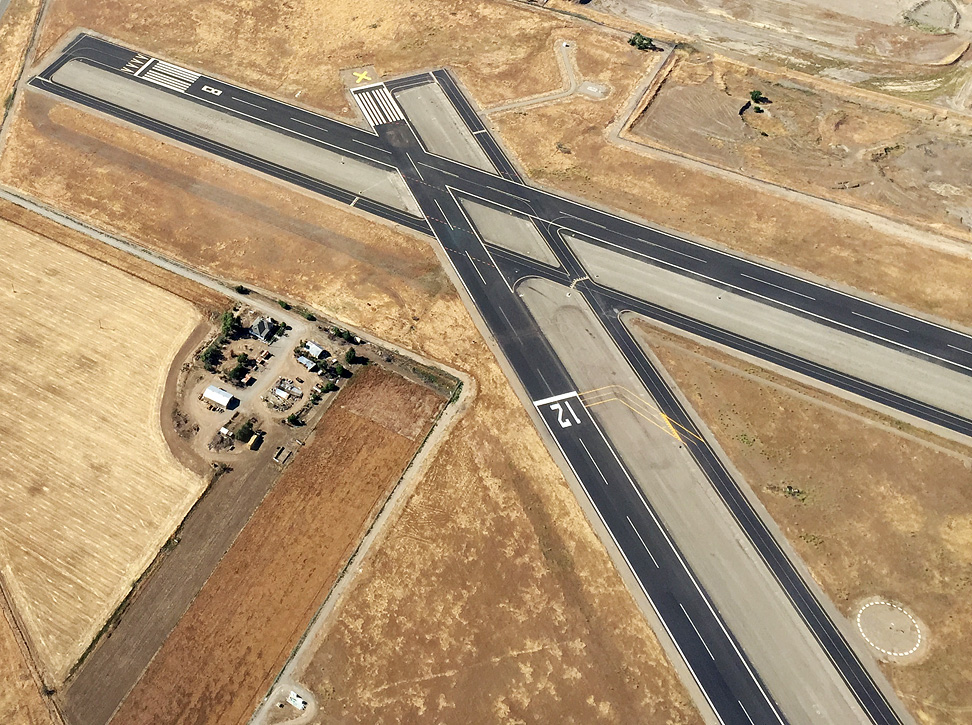
Steve felt I really needed more practice with landings – they were pretty bad on sunday due to infrequent flying. So we planned to touch and go at Byron. However the winds were not calm (from 230 at 10, gusting 15). So we rerouted for Tracy (350 at 7kts) but runway 12/30 has been significantly shortened and more importantly, 8/26 has been completely taken out for re-paving! We decided to re-route to New Jerusalem. Two landings and the third was a go-around since the approach was not good. In between, Steve demonstrated a short field landing and takeoff. Overall, I owed him $16.50 if you counted $0.50 for each “right rudder” prompt.
Today was the first time I used a second GoPro in the cockpit. I had it pointing to the right, suction mounted on the rear window. With the engine under any power, the vibrations were too much and readily picked up by the GoPro. I need to find a better mounting location.
Three power off stalls straight ahead attempted. Second one didn’t really stall. On the first one, the wing dropped to the right while entering the stall and I inadvertently corrected through left rudder while also relaxing back pressure to break the stall. Steve formalized this and showed me stalls on a turn on both right and left turns. Stall on a left turn could lead to a spin if one is not careful. I tried a couple of stalls on a right turn before we moved to engine out simulation.
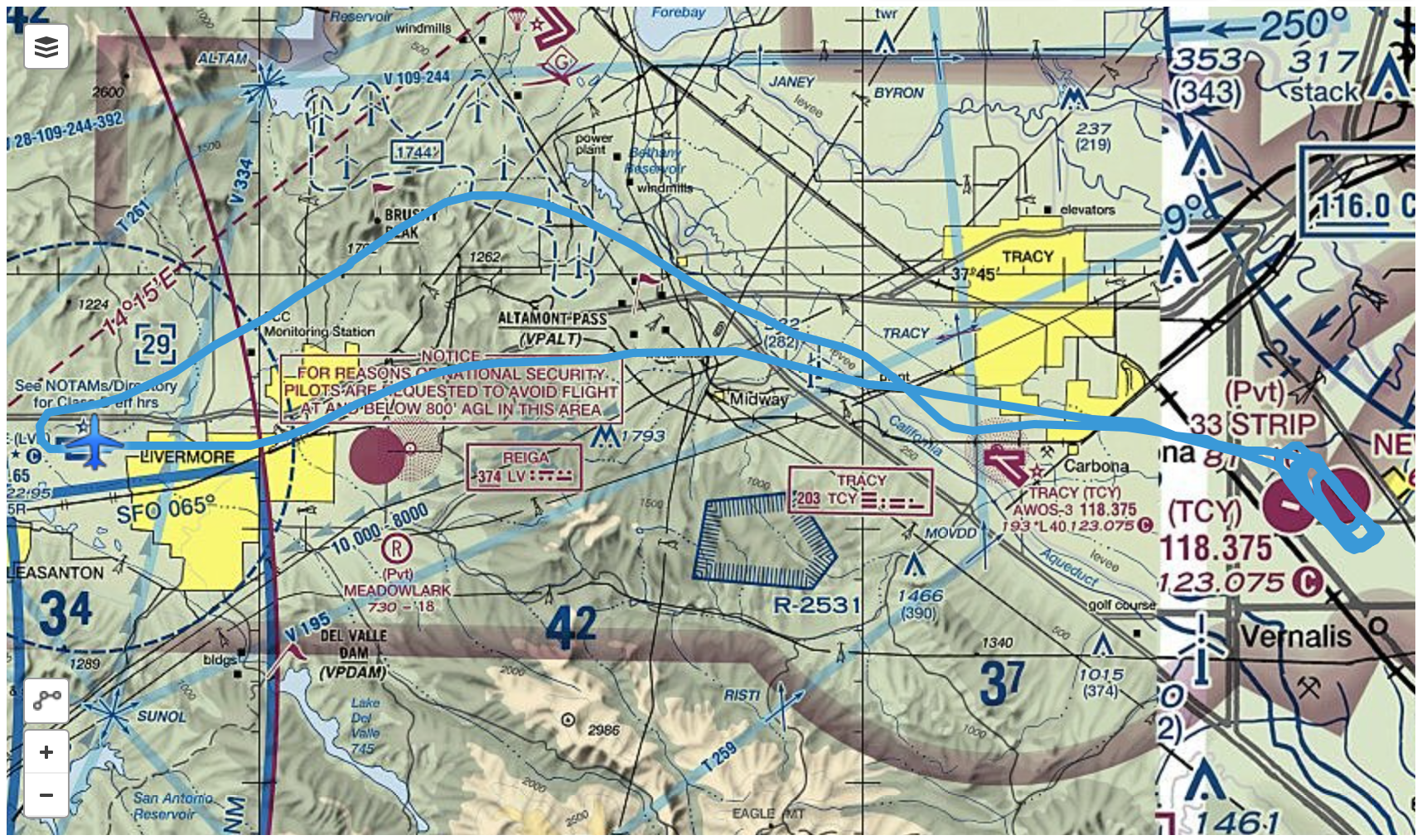
First, trim for a 65kts glide speed. Next, check the usual suspects for why the engine might be out – fuel selector, mixture, magnetos. If you have ruled these out as probable causes, find out the wind direction and quickly scout for a place to land. Preferably land into the wind. We picked out a field that had stubble and eliminated other fields that were green, or had been plowed recently. Since the field was pretty close to where we were, we did a 360 degree turn and after confirming that we would land there comfortably, we pushed the throttle. The track log below ends right after we started climbing out.
Finally, a few touch-and-go’s at Livermore. We were given 25L and left closed traffic after the first landing. I didn’t remember the controller’s instructions and inadvertently turned final for 25R. Steve hurried my turn and fortunately there was nobody else at that time on approach to 25R. On another pattern, the controller asked us to turn crosswind and when I hesitated, Steve banked quickly left. Why we got that instruction is irrelevant but that is exactly what I was analyzing. These were two good lessons in staying vigilant and reacting quickly.
We started with an engine out simulation as we were climbing on downwind leg out of Livermore. Steve explained why we couldn’t go back to Livermore – because of headwinds if we turned towards the airport. After scouting a place to land, we quickly pushed the throttle back in and climbed on.
After we crossed the hills east of Livermore, Srinath tried three power off stalls. On the second one, the stall wasn’t fully reached before recovery and that is clear from the video where the nose didn’t quite drop.
Next, Steve showed us something new [2:55 into the video]. He forced a stall and instead of relaxing the back pressure as we usually do to break the stall, he kept it all the way back. So the plane continued to be stalled. One of the wings (left) dropped and without using the ailerons, used only the rudder to pick up that wing. [In the audio, Steve misspeaks about the right wing being down and using the right rudder to compensate]. Then he asked Srinath to hold the elevator all the way back and use only the rudder. He later mentioned that it was called the Falling Leaf Stall.
I needed to research this maneuver because we didn’t discuss it further that day with Steve. It turns out to be an uncommon high air work and found this article in the AOPA Flight Training magazine from 1998. In short, by keeping the wings level this maneuver makes the plane resemble a falling leaf. As the wings rock, it is picked up by using opposite rudder. In a stall, the ailerons have very little to no authority. The rudder is above the turbulent air flow washing off the wings and hence still has authority allowing the yaw to compensate for dropping wings.
We got to about 2000′ MSL and we ended the maneuver by breaking the stall and powering up the engine. Next was turns around a point and then figure 8 turns. Winds were from 220 at 21kts so that certainly made the ground references challenging.
We proceeded to Byron. Winds were from 220 at 22 gusting 29. It has been the most sustained turbulence we have experienced thus far in training. Srinath suggested we’d land on Rwy 30 which was the wrong choice. So Steve decided to give us an education by attempting the landing and then doing a go-around when the full rudder deflection wasn’t sufficient. The plane was visibly crabbed at an extreme angle and that was still insufficient for the launch. After the go-around, Srinath did two landings on Rwy 23 before heading back to Livermore for a landing well after sunset.
Steve gave us a heads-up that we will fly over the Tracy airport so we can see some changes for ourselves. The runways were getting a makeover aka resurfacing. The threshold for Rwy 12 has been relocated so that Rwy 8/26 can be reconstructed. So the usable portion of 12/30 is now significantly shorter. Taxiways had been redrawn.
Next, Srinath had a chance to practice slow flight and shallow turns and a power-off stall. He lost just a couple of hundred feet during recovery. Next was ground reference maneuver – turns around a point. Today the sight picture beneath us was a rectangular area as opposed to a crop circle as we’ve seen before. Finally, a few cross-wind landings at New Jerusalem before heading back to Livermore.


 Crab Tales