Srinath’s first solo

Today we turn left downwind towards our usual practice area. Winds 300@15. As soon as we turned downwind, the controller asked us if our transponder was working. It turned out that we had not turned on the transponder! Note to self: add this to the checklist when we check if the radios are set.

Steve handed Srinath stylish eyewear and Srinath flew under the hood, maintaining 3000′ on heading 095. Later he navigated using a couple of VOR stations that Steve tuned in. After reaching our practice area, Srinath was asked to stall the plane in a clean configuration under the hood (using instruments only) for the very first time. Next, Steve asked Srinath to forward slip the plane in order to lose altitude since we were pretty close to crop circles and Steve was planning a ground reference maneuver for turns around a point (maintaining 600′-1000′ AGL typically). After turning around a crop circle, Srinath turned around a lone tree nearby for another ground reference maneuver.

At this point, Steve pulled the power and simulated an engine out. Srinath had to react quickly to establish a glide slope and scout a place to land. New Jerusalem was close by but with the engine out, we could not make it that far. Steve spotted a road nearby and as we got pretty low, it was time to gun the engines and make a go for New J.

Srinath did three landings at New J. On one of the approaches, Steve said there is a cow on the runway, prompting Srinath to react quickly and do a go-around. On the third landing, Steve took over the plane and declared that Srinath was going to fly solo. It came as a surprise to both Srinath and I, neither of whom were mentally prepared for this occasion. Later, Steve would tell me that he solo’ed Srinath because his landings were consistently good.

While Steve signed Srinath’s logbook and his student certificate (3rd class medical) with the solo endorsements, I reminded Srinath that Steve would not have solo’ed him unless he felt Srinath could handle it. But that Srinath had to be very mindful of maintaining airspeed especially on the turns to base and final and not hesitate to do a go-around if he didn’t feel things were going well on the approach. Even more importantly, never to get over confident especially when things are going well.

Soon Srinath was on his way and Steve and I watched him like grounded hawks, listening to the engine drone and running a commentary guessing his actions based on auditory and visual inputs. There he pulls back to 1500rpm and there he pulls the first notch of flaps etc. His first landing was great and Steve was so excited that he jubilantly pumped his fists in the air, shrieked and and danced in joy. I was excited too, but more importantly I was videotaping his landing. Seeing the plane on a steady approach gave me confidence. His next two landings were good too and he turned around on the runway to taxi back towards us.

Later while viewing the in-cockpit video, I could tell that Srinath’s voice and tone got more and more confident with each go-around. Clearly he was understandably excited after completing his solo. My only worry again was that he shouldn’t get over confident. It was a proud moment for a father to see his son complete this milestone.

After a few minutes, Steve and I get into the plane to head back home. Srinath cranked the engine. The prop turned once then seized. No luck even after pumping the throttle and retrying. Steve got off the plan to hand crank the prop the old fashioned way. Three tries and still no luck. The prevailing theory was that the battery was dead and a spare battery was in our hangar at Livermore. We were stuck at the New Jerusalem airport. In the middle of nowhere (which is the reason Steve likes to solo his students here). Nobody in sight.

We unload the plane and scouted around for decent sized rocks to secure the wheels. It was dusk and pretty soon it would be pitch dark. Steve called a couple of club members and got hold of Doug who was once Steve’s student. We hoped that Doug would drive up to Livermore from his home in Pleasanton and fly the Cessna 182 to New J to pick us up. Tomorrow, Steve would haul the spare battery and drive up to New Jerusalem with somebody else to start the engine and fly the 172 back to Livermore. However, given how late in the evening it was, Doug was not comfortable flying the 182 knowing it would be nearly dark by the time he arrived at New J. The runway is not lit so it would be a challenge for somebody flying solo to locate the airport at all. Doug made a good call of driving over in his truck. And he had the presence of mind to call one of his friends who lived in Tracy to head over to New J to meet us, since it would take a while for him to drive over. His friend showed up within 10 minutes.

In the meantime, we secured the plane, carried all our gear and walked towards the gate. Unfortunately the gate was locked from the outside and we couldn’t find an opening to get out. Doug’s friend drive along the fence and came back to report that there was no exit! As if Srinath’s solo wasn’t exciting enough for the day, Escape from New Jerusalem was going to keep our adrenaline pumping for a bit longer.

Steve had worked for Caltrans and was hoping that Doug or his friend would have a shovel in their truck. This was an old trick Steve had employed in his past life. Stick the shovel’s handle through the chain link fence, halfway to the top. Once person would hold the shovel on the other side of the fence while we stepped on the protruding part inside the fence to hop over. Unfortunately, neither Doug nor his friend had a shovel. We tried improvising but nothing worked. By now it was dark so they had to turn on the headlights towards us so we could plan an exit strategy.

Doug had two large water drums on his flatbed truck. So we planned to toss one inside the fence and pull up the flatbed truck all the way to the fence. That way we could step over the drum, jump over the fence and land on his flatbed on the other side. Everything seemed to be going well until it was my turn. Since I wasn’t tall enough, I was barely able to kick one leg over the fence and land on the flatbed on the other side. Unfortunately the other leg was still on the drum and I was stuck straddling the fence at the top. The chain link caught my jeans at an unspeakable location and it wouldn’t free itself. Neither could I force it off. After much struggle and with help, we were able to tear the jeans off the fence so I could cross it.

So now the drum was still inside and all of us were outside. We couldn’t leave it this way so were stuck again, trying to find a way to haul the drum over. Miraculously, Doug had a shovel in his flatbed unbeknownst to him. So finally we had a chance to try Steve’s trick. Doug hopped over the fence onto the protruding shovel handle, tossed the drum over and then jumped off the shovel safely onto the truck. We were all clear. Finally! What a surreal night.

Using the maps app on our smartphone we navigate our way out of New Jerusalem’s backroads in the darkness to Tracy and then to I-580. It was almost 10pm by the time we got back to our hangar in Livermore. After filling out our logbooks we were back home around 10:45pm. Hopefully N25ES would be safe in New J for the night.

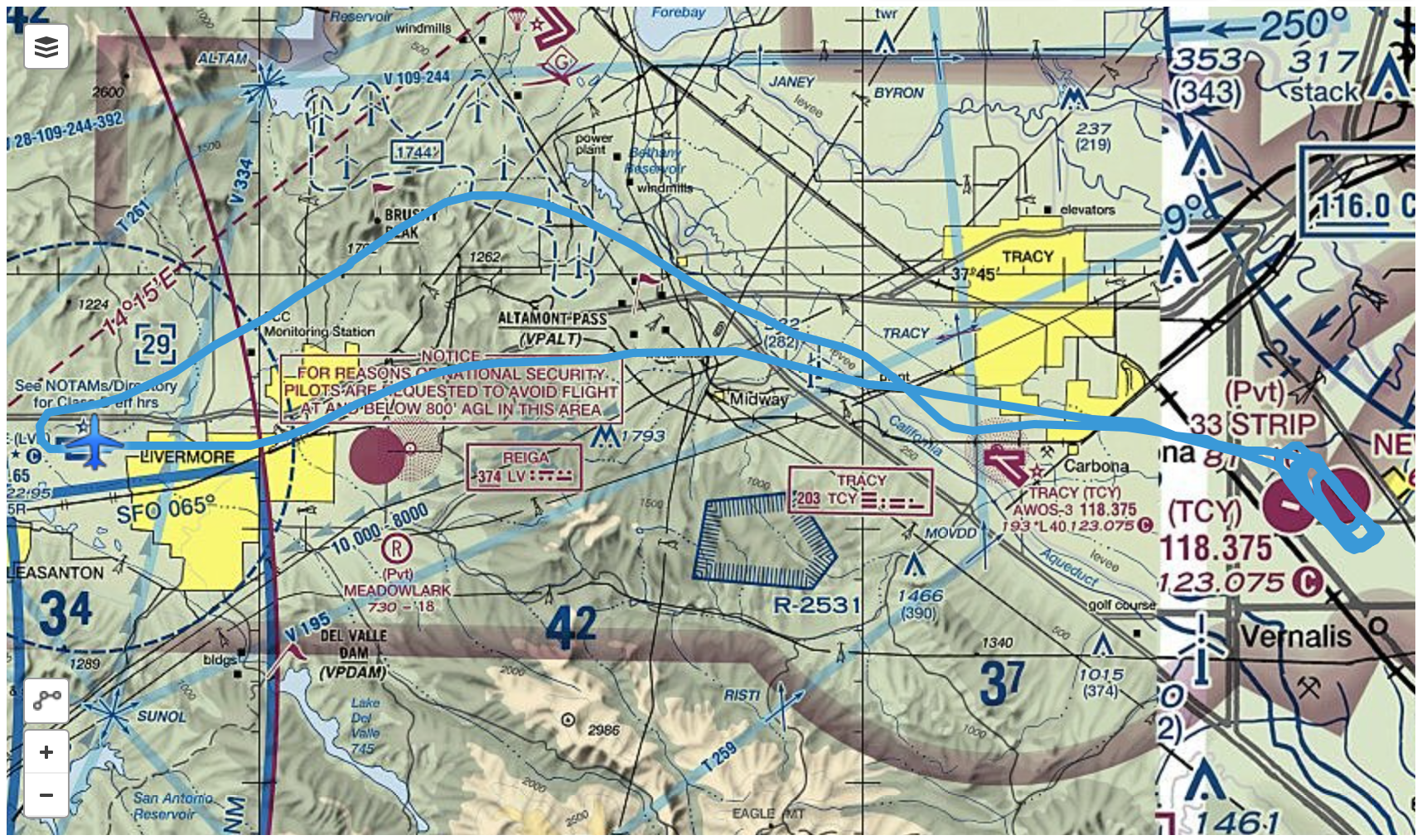
Here is the flight track log.
Wings of Freedom

The annual Wings of Freedom Tour is going on this weekend at the Livermore airport. As we pulled up beside our hangar, a B-17 Flying Fortress “Nine 0 Nine” was going through its run up check prior to takeoff. The Collings Foundation offers tours on its fleet of WWII aircraft as they tour around the country. The sound of its Wright-Cyclone engines thumped through the air and echoed off the nearby hills. Our hangar is one of the closest to the run up area and a group had gathered for best views and to photograph the spectacle.

We took off on 25R and headed right downwind. As we were climbing, Steve spotted a B-25 on our right heading towards the airport to perform an overhead break. Very soon Steve handed me stylish eyewear, his term for the instrument hood. After maintaining different headings, Steve asked me to stall the plane. Under the hood! Without realizing, I ended up in a falling leaf stall so I did it again, this time consciously and without the hood. The plane was clearly unhappy as it bounced around in a stall condition.

Today we tried boxing the sky for the very first time. Using full rudder to move the nose to the left and right while at the same time using the ailerons to keep the wings level. After a few boxes, we headed to the New Jerusalem airport. It was pretty close by and we had quite a bit of altitude to lose so we did a side slip with nose slightly nose down and fully cross controlled. We did 5 touch-and-go at New J before heading back to Livermore.

As we got close to Tracy to turn west towards Livermore, the B-17 passed ahead of us and we followed it all the way to Livermore. He was lower so we didn’t have any threat from wake turbulence. We did watch where he landed so we could touchdown farther to avoid the wake turbulence on the runway. The bombers were done for the day and we taxied past them on our way to fuel.

had never seen these WWII aircraft in airworthy condition, let alone flying or taxiing amidst these heroes. Today was a memorable day! Here is the full flight track for the day.

Falling Leaf Stall, Ground Reference Maneuvers, Touch and Go

Winds 230@12, foggy morning but we saw some holes in the south east sky. So we are going to poke through it because east of the hills is supposed to be clear weather. The climb was quite turbulent as we stayed low below the clouds, but high enough to clear the hills. This was the first time we’ve flown through scattered clouds. Along the way, an aerial view of Lake Del Valle with its dark green waters was quite rewarding. We kept poking through holes in the clouds and following valleys beneath to maintain the maximum possible ground clearance. Once we crossed Lake Del Valle, it was time to bank left and head for the central valley.

Srinath started with the falling leaf stall – his first time consciously doing the maneuver. As expected, the plane buffeted and was unhappy (to quote Steve) because Srinath kept the elevators aft and used the rudders to maintain wings level without letting the nose drop. Then time for a few touch and go’s at New Jerusalem. However we were too high at 2000′ and Srinath used a side slip to lose some altitude quickly.

Next, turns about a point. First around a crop circle counterclockwise and then clockwise. Next, we moved west to find a point on the ground (a house) and then turns to the left and then the right. Along the way, we heard on the radio that skydivers were jumping off  an airplane at 13,000′ over Lodi airport.

More landings…

The morning starts off being unusually cold for this time of the year. The temperature was just below 60 degrees F and the ceiling was low at 1600′. Srinath was away at a Boy Scouts Camporee. So I planned to practice touch and go at Livermore and our traffic pattern was to be 1200′ instead of the usual 1400′. Overall, there was no consistency in the landings. Once the plane bounced, another time the landing was a greaser, and the remaining attempts were somewhere in between. On the second touch and go, the airport briefly closed 25R for runway inspection. So we extended our downwind until we got clearance from the tower to turn base. All the while I did not speak a single word on the radio while in flight because my brain was full just focusing on flying the plane.

The key is to remember to use the rudders to keep the plane aligned parallel with the runway. This is because when the plane touches down, the wheels should be parallel to the runway otherwise there will be a twisting moment on the landing gear. While the rudders keep the plane parallel to the runway, ailerons should be used to produce lateral movement if the plane is not on the centerline. This general principle works particularly well in crosswinds. If the rudder keeps the plane parallel the runway, the crosswind is going to push the plane laterally. This is countered by dropping the wing upwind (thus causing the plane to roll into the wind) countering the crosswind. In this landing configuration, the upwind main wheel is going to touch down first. By maintaining the upwind wing down, the plane must roll on the runway for as long as it can and as the speed bleeds off (and consequently the effect of the crosswind dies down), the other main wheel will touch down and eventually the nosegear.

I have been clearly using the rudder to stay on the runway, not to stay parallel to the runway. This is a key distinction. And I have been using the ailerons to keep the wings level. Whenever Steve asked me to step on the right rudder, he was doing so with the intention of keeping me parallel to the runway. But this confused the heck out of me because I was using the rudder to stay on the centerline. Often when Steve asked me to step the right rudder, I would have been stepping on the left because of our very different mental intentions.

The other observation is that the approach should be stabilized. That means 65kts and on the proper glide slope. What you see instead in the video is the nose dancing all over the place requiring constant hands on flying by the PIC. If the approach is stabilized, the landing becomes much more controlled, predictable and repeatable.

First night cross-country flight

The days are getting long and that means sunset is later in the evening. A few days ago, Steve gave a route for Srinath to plan his night cross country trip. We were to leave Livermore for the Sacramento Executive Airport (KSAC), then Rio Vista (O88) followed by Kingdon (O20) and back to Livermore. We created a cross Cross Country Flight checklist as a PDF document with form fields and used this cross country trip as a trial subject. Anyways, we are now set with all the details and Srinath even received a full weather briefing through 1-800-WX-BRIEF. We were to meet Steve in the hangar at 8:30pm right around sunset. While night flying hours can be logged beginning with civil twilight, we were going to take off an hour after sunset.

Earlier this evening, Srinath had an appointment with the AME in Pleasanton to apply for a third-class medical certificate and it went pretty smoothly. It was a big relief!

We got to the hangar a little early and started the preflight checklist. When we flew a couple of days ago, we noticed that the landing light was not working and it had been placarded. It would be interesting to land without landing lights nevertheless Steve cleared us to go flying that night. We spent a good bit of time reviewing the planned details of the cross country trip with Steve. I set up Foreflight on my iPad so I could follow along the planned course.

Night flying is very different. First of all, there was no ATIS, no Ground or Tower controllers – it was past the operating hours – so we announced our intentions to Livermore Traffic on the CTAF. There were very few planes flying around at night and those that were flying could be spotted by their position lights. Depth perception wasn’t the same as while flying during the daytime. Thankfully this was a full moon night and the landscape was lit quite well. Watching from the back seat the moon rise over the horizon was quite a feeling. Photography was difficult due to extreme low light conditions. The GoPro picked up city lights but the rest of the time during our cruise it was pitch black outside and very dim inside the aircraft. The two massive towers (roughy 2050′ tall) northwest of Lodi stood out like sore thumbs.

Sacramento Exec airport was at first a little hard to find because it was engulfed by the city lights. There was another pilot announcing his intentions to take off from the airport while we were on the downwind leg. This landing turned out very smooth and we taxied off the runway to pause and regroup for the next leg to Rio Vista. En route to KSAC, we saw O88 to the west of the two massive towers so we simply looked for its airport beacon as we took off from KSAC. As I followed along on Foreflight, we basically tracked over the deepwater shipping canal. Suddenly we heard a high pitched sound and for a few seconds we were trying to figure out what was wrong. The terrain was almost pitch black so emergency landings would be impossible if needed. Thankfully it turned out be just a radio problem and we were able to resolve it quickly.

O20 Kingdon airport was almost impossible to find. It took quite a while to locate the airport in the darkness (see video). The airport didn’t have a beacon and the lights when keyed with the mike stayed on for just a couple of minutes. Srinath looked at the freeway and correctly guessed that we were almost overhead of the airport. Keying the mike proved it and we had quite a bit of altitude to lose. So we circled over the airport watching for any signs of winds as we shot for Rwy 30.The runway edge lights were placed quite far apart and that make it even more difficult to stay in the center of the runway. Finally the last leg back to Livermore was quite uneventful.

Here is the foreflight tracker. http://www.foreflight.com/s/track/1430886307-780FAB33-6427-4269-95FE-3B853966A072/

More landing

Steve felt I really needed more practice with landings – they were pretty bad on sunday due to infrequent flying. So we planned to touch and go at Byron. However the winds were not calm (from 230 at 10, gusting 15). So we rerouted for Tracy (350 at 7kts) but runway 12/30 has been significantly shortened and more importantly, 8/26 has been completely taken out for re-paving! We decided to re-route to New Jerusalem. Two landings and the third was a go-around since the approach was not good. In between, Steve demonstrated a short field landing and takeoff. Overall, I owed him $16.50 if you counted $0.50 for each “right rudder” prompt.

Today was the first time I used a second GoPro in the cockpit. I had it pointing to the right, suction mounted on the rear window. With the engine under any power, the vibrations were too much and readily picked up by the GoPro. I need to find a better mounting location.

Screen Shot 2015-06-11 at 8.24.14 PM

Stalls on a turn

Three power off stalls straight ahead attempted. Second one didn’t really stall. On the first one, the wing dropped to the right while entering the stall and I inadvertently corrected through left rudder while also relaxing back pressure to break the stall. Steve formalized this and showed me stalls on a turn on both right and left turns. Stall on a left turn could lead to a spin if one is not careful. I tried a couple of stalls on a right turn before we moved to engine out simulation.

First, trim for a 65kts glide speed. Next, check the usual suspects for why the engine might be out – fuel selector, mixture, magnetos. If you have ruled these out as probable causes, find out the wind direction and quickly scout for a place to land. Preferably land into the wind. We picked out a field that had stubble and eliminated other fields that were green, or had been plowed recently. Since the field was pretty close to where we were, we did a 360 degree turn and after confirming that we would land there comfortably, we pushed the throttle. The track log below ends right after we started climbing out.

Screen Shot 2015-05-30 at 9.51.31 PM

Finally, a few touch-and-go’s at Livermore. We were given 25L and left closed traffic after the first landing. I didn’t remember the controller’s instructions and inadvertently turned final for 25R. Steve hurried my turn and fortunately there was nobody else at that time on approach to 25R. On another pattern, the controller asked us to turn crosswind and when I hesitated, Steve banked quickly left. Why we got that instruction is irrelevant but that is exactly what I was analyzing. These were two good lessons in staying vigilant and reacting quickly.

Falling leaf stall

We started with an engine out simulation as we were climbing on downwind leg out of Livermore. Steve explained why we couldn’t go back to Livermore – because of headwinds if we turned towards the airport. After scouting a place to land, we quickly pushed the throttle back in and climbed on.

After we crossed the hills east of Livermore, Srinath tried three power off stalls. On the second one, the stall wasn’t fully reached before recovery and that is clear from the video where the nose didn’t quite drop.

Next, Steve showed us something new [2:55 into the video]. He forced a stall and instead of relaxing the back pressure as we usually do to break the stall, he kept it all the way back. So the plane continued to be stalled. One of the wings (left) dropped and without using the ailerons, used only the rudder to pick up that wing. [In the audio, Steve misspeaks about the right wing being down and using the right rudder to compensate]. Then he asked Srinath to hold the elevator all the way back and use only the rudder. He later mentioned that it was called the Falling Leaf Stall.

I needed to research this maneuver because we didn’t discuss it further that day with Steve. It turns out to be an uncommon high air work and found this article in the AOPA Flight Training magazine from 1998. In short, by keeping the wings level this maneuver makes the plane resemble a falling leaf. As the wings rock, it is picked up by using opposite rudder. In a stall, the ailerons have very little to no authority. The rudder is above the turbulent air flow washing off the wings and hence still has authority allowing the yaw to compensate for dropping wings.

We got to about 2000′ MSL and we ended the maneuver by breaking the stall and powering up the engine. Next was turns around a point and then figure 8 turns. Winds were from 220 at 21kts so that certainly made the ground references challenging.

We proceeded to Byron. Winds were from 220 at 22 gusting 29. It has been the most sustained turbulence we have experienced thus far in training. Srinath suggested we’d land on Rwy 30 which was the wrong choice. So Steve decided to give us an education by attempting the landing and then doing a go-around when the full rudder deflection wasn’t sufficient. The plane was visibly crabbed at an extreme angle and that was still insufficient for the launch. After the go-around, Srinath did two landings on Rwy 23 before heading back to Livermore for a landing well after sunset.

KTCY is getting a makeover

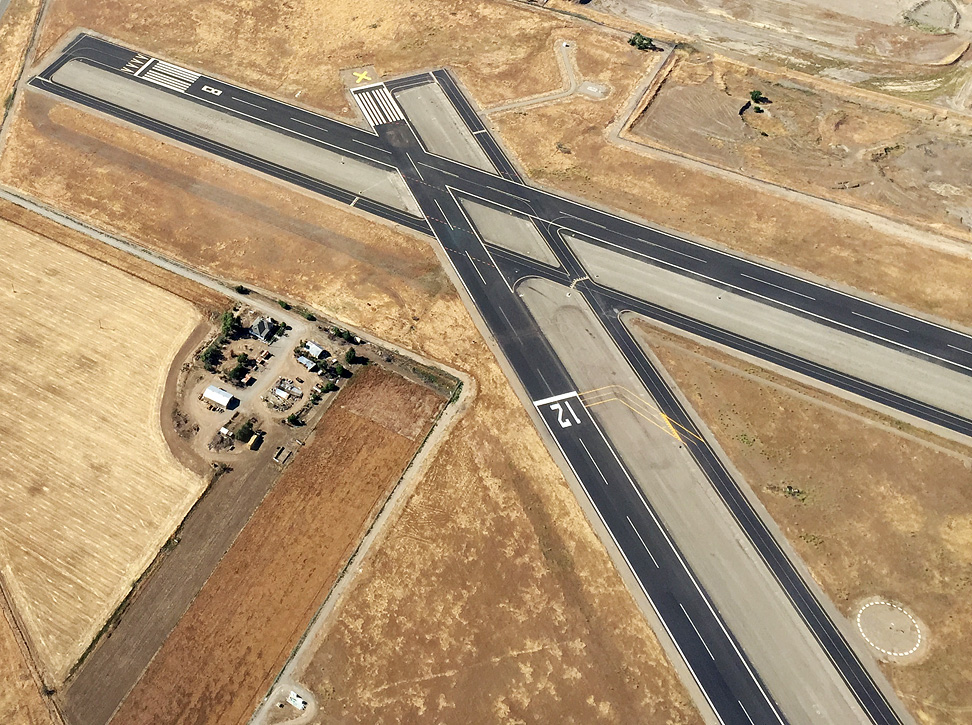
Steve gave us a heads-up that we will fly over the Tracy airport so we can see some changes for ourselves. The runways were getting a makeover aka resurfacing. The threshold for Rwy 12 has been relocated so that Rwy 8/26 can be reconstructed. So the usable portion of 12/30 is now significantly shorter. Taxiways had been redrawn.

Tracy Runway Makeover

Next, Srinath had a chance to practice slow flight and shallow turns and a power-off stall. He lost just a couple of hundred feet during recovery. Next was ground reference maneuver – turns around a point. Today the sight picture beneath us was a rectangular area as opposed to a crop circle as we’ve seen before. Finally, a few cross-wind landings at New Jerusalem before heading back to Livermore.

Apr19TrackLog