I’m flying with Steve today on dual instruction. As we climbed out of Livermore, I noticed deteriorating visibility which I assumed was a cloud layer. Steve pointed out that it was actually smoke from a very large wildfire burning near Big Sur on the California coast. On the east side of the Livermore ridge the conditions were a little better, enough for us to continue with a training flight after having had thoughts along the way of possibly turning back.
At 3000′ the smoke layer wasn’t bad so I did steep turns on the right and left. Still not very comfortable doing steep turns. Steve demonstrated a turn which was fairly steep and he might have pulled up to keep the nose from dropping and I was not comfortable with the associated sensations.
Next we did slow flight and then a few different stalls – power off stall in the landing configuration, power-off stall on a right turn and then a power-on stall.
We went through a routine engine out simulation and at the end of it we spotted the pipeline and transitioned into S-turns. At that time I spotted another aircraft which was also flying at our low altitude seemingly also using the pipeline for making S-turns. We watched it for a while as it appeared they were leaving the area but then they really didn’t. After one turn we decided to leave the area and do turns about a point at a nearby location.
Lots of traffic everywhere today. As we were approaching Byron and announced our position over Discovery Bay, another aircraft was taking off and was going to do a 270 en route to Livermore. That would put it coming straight at us at comparable altitude. Radio communications helped save the day with each other knowing our locations.
There were gliders flying today at Byron and there was unexpected thermals as we approached the threshold for Rwy 30 that caused me to stay up longer even though I had pulled out the power on the engine. Two touch and go and we headed back to Livermore.
Today I set out to practice solo stalls for the first time. I had 737GM reserved and it was mostly a smooth ride as I flew over Byron airport at 2500′ heading to the practice area. At 3000′ I started practicing slow flight and making shallow turns at slow flight. But first, by making clearing turns.
After slow flight, in the landing configuration I tried a stall first and then dropped the nose before the stall was achieved. Tried it again and this time the stall was achieved with quick recovery. Very quickly I decided that was enough and proceed for a couple of touch and go’s at Tracy airport before heading back to Livermore. By the time I returned, winds had shifted and I landed on 7L as tower switched the traffic around to make up for a northeasterly wind.
Starting up 737GM was a bit of a bear but chose to fly it this morning because 906MD’s carburetor was being re-worked due to starting problems. Tower cleared me for takeoff on 7L. Winds 130@5kts but quite variable.
Flight to Byron was quite straightforward and it was a good smooth landing. On the flight from Byron to Tracy, I had still been tuned to the Byron radio and I was wondering why Tracy traffic wasn’t announcing on the radio. I was still hearing Byron traffic. While in the pattern at Tracy, I saw an aircraft taking off and one waiting to take off and I had not heard either of them speak on the radio. It was only when I was nearing base turn in the Tracy pattern that I realized my mistake. Landing at Tracy was also good. I next proceeded to New Jerusalem where it was a bouncy touch and go. The flight back to Livermore was uneventful.
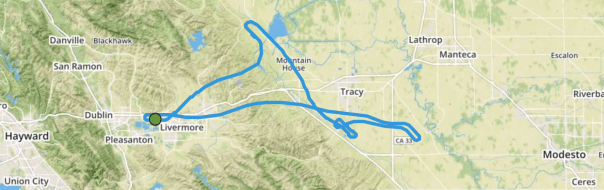
Today was my first solo flight taking off and flying outside of Livermore. I went to Byron, then Tracy and back.
As I requested frequency change approaching brushy peak, tower alerted me to traffic in the opposite direction which I never was able to locate. After touching down at Byron, I taxied off to reset for the leg to Tracy. On the way back to Livermore as I approached Altamont, tower first alerted me to a traffic 1mi south for straight in to 25R and asked me to report for a 2mi right base implying I had to turn right towards brushy peak. Then tower changed the instructions to make a right 360 and then straight in for 25R.
Srinath was on the left seat today and he started with a soft field takeoff and left downwind departure. At Tracy, winds were from 310@7kts where he did a soft field landing. The sink hole just past the threshold of rwy 30 is to be respected. There is usually an appreciable downdraft as the plane passes over the sink hole so anticipate it and increase the power a little bit. As you clear the sink hole and approach the threshold, ease back on the power and the word I keep hearing Steve repeat is “patience…patience” to wait for the runway to approach the aircraft. In other words, descend slowly for a gentle touchdown.
Next we headed for New Jerusalem by making a left 270 over the runway and passing over mid-field. The runways at both Tracy and New J were slick and wet from rains and that calls for extra caution while using brakes. We landed twice at New J, the second landing took up quite a bit of runway so we turned around. And since the winds were low (estimated 8-10kts), Steve asked Srinath to take off on rwy 12 so he can see how the tailwind leads to a significantly longer ground roll before takeoff.
Next, we headed to Byron against stiff headwinds from 310@15kts. We heard a Piper (58K from our club) on the radio practicing patterns and a glider coming in to land at the airport as well. This was a great practice session anticipating where the traffic would be as we executed a straight-in approached for rwy 30. Steve had a little fun on the radio with Mike (CFI on 58K) when he recognized the voice. Srinath and I both had questions for Steve as we were trying to figure out the spatial locations where the three aircrafts would be as we approached further. Since 58K was on final and we were coming up on 5 miles, we anticipated that we’ll land before 58K comes around for its next pattern. What we didn’t factor into the equation was the fact that we were going against a stiff headwind in a low power setting for landing and 58K would be gunning its engines for takeoff, followed by a stiff tailwind towards us on the downwind leg. Our ground speed was only 40kts and then 35kts as we got lower and closer.
Mike couldn’t spot us so we announced that we were a quarter mile shy of the second canal. What Steve meant was the second canal seen from our approach the runway i.e. the closer one to the airport. Mike understood that we were on the second canal from the airport i.e. the farther one from the airport. So he announced that he was turning base in front of us. We were all taken by surprise when he announced that and saw 58K turn directly towards us. Steve immediately took evasive action by banking left and as soon as we turned, Mike was able to see us and apologized for the mixup. We let Mike land and in the meantime we did a left 360 and lined up to land on rwy 30.
Srinath capped off the training with a few touch-and-go’s at Livermore performing short approach landings.
Today wind was 240@9kts at Livermore.We departed right downwind towards Byron where the wind was 210@6kts and clear skies.Apparently I was still on Livermore tower frequency (00:21:12 in the video) when I announced on the radio that we were inbound for Rwy 23. We did a short field landing (02:09:00) at Byron followed by a maximum performance takeoff (02:35:00). Next we proceeded to Tracy (winds 260@10) and did a soft field landing on Rwy 26 (05:32:22) followed by a regular takeoff.
We next headed to New Jerusalem which is only 7 miles away and aimed for Rwy 30. Winds were from 260 (no ATIS or AWOS in New J so we go by the Tracy weather) so it was a crosswind (06:39:00) for Rwy 30. We only employed 20 degrees of flaps and that caused us not to sufficiently slow down and remain low for landing. As we approached the runway, the airspeed got very low to 50kts and Steve pushed the throttle for a go-around at the last minute (07:32:19) as the stall horn started going off. I was apparently not watching the airspeed at all, being more intent on getting the plane low enough (through a slip) for the landing (10:02:04). That was a close call. On reflection, the thought did cross my mind that perhaps I should go around given I was so high. I should have gone around as soon as the thought crossed my mind. We did two more successful attempts before heading back to Livermore.
Over the Altamont pass just before I was going to call Livermore tower, I saw an aircraft coming straight at us. I simply pointed it out to Steve (11:32:24) who immediately banked us sharply to the left and we noticed the other aircraft pass us (slightly below). It seemed like it would have been a head-on approach and that got me quite shaken up. I should have gotten us out of trouble the moment I saw the aircraft. In reviewing the radio communications just prior, there were two aircrafts that had departed Livermore. 53MM was ahead of 7E(something) and 7E(something) confirmed to the tower that the Cherokee traffic ahead of it was in sight (11:02:11). Tower then approved 7E(something) for a frequency chance and then radio’ed 53MM that traffic was behind to its left at 2500′ and had 53MM in sight. 53MM’s frequency change was next approved. So both those aircraft were heading towards us and no longer talking to Livermore Tower. We were tuned into the Livermore Tower frequency but the three of us were neither talking to each other, nor talking to the Tower. We were in a see and avoid territory and while I saw what was most likely 53MM, I was slow to avoid. Maybe I had a premonition about this event because I asked Steve a question at the start of our flight (00:02:18 in the video) about how we deal with oncoming traffic that uses the same general path.
Back at Livermore, Steve sent me off to fly my solo in a pattern around a towered airport. I did 3 touch and go’s and on all three attempts I was #2 behind another aircraft. I had to extend my downwind leg, watch for the aircraft ahead of me before turning base.
We departed 25R on a left downwind departure towards New Jerusalem and just as we took off, Steve pulled the power without warning. Srinath did the right thing by “flying the plane” and landing it back on the runway. Steve then pushed the throttle in and we took off. This was a lesson in emergency procedures since the engine could quit just at takeoff. In that case, the best place to land is straight ahead. Never try to turn back to the runway because that effectively requires a 270 degree turn in one direction and then a 90 degree turn in the opposite direction to line back up with the runway. At low altitudes with engine out this turn is almost always impossible to make. In the heart-thumping moments, getting into a stall spin accident becomes likely and with grave consequences. No matter what is ahead, the best bet is to land it almost as straight ahead as possible with minor corrections.
Once at New Jerusalem, Srinath practiced soft field landings and takeoffs as well as a maximum performance takeoff. We next headed to Byron to fill up gas because the new gas station at Livermore isn’t fully functional yet. On approach to Byron, Srinath did a straight-in landing and this time a precision landing on the numbers.
After re-fueling, we taxied back to runway 30 and heard a heads-up that skydivers (jumpers) were heading down from 10,000’. It was incredible that they came down in no time at all, well before we completed the run-up checks and were at the hold short line for runway 30.
We waited for a tricycle geared Maule to land. Steve referred to this as a “quintessential bush plane”. Normally they are tail draggers so it was interesting to see one in a tricycle gear. There was a lesson in not hurrying to the threshold for takeoff because the Maule hadn’t yet turned off Rwy 30 on a taxiway. Just as we got ready to takeoff, more jumpers were getting ready to unload at 13,000’.
Just as we were over Brushy Peak heading in to Livermore, I noticed gas gushing out of the fuel vents like crazy. Never seen so much fuel come out in such volume continuously. Steve asked if the fuel caps were on, which they were. In measuring the fuel after the flight, we estimated about a gallon was lost! Not sure what caused this…
Today the winds were calm and clouds were 4900′ scattered. As we taxied out, we noticed that the construction of Three Rivers FBO is making good progress and they are getting ready to open by Super Bowl. The new fuel station has been opened and the old one removed. Miraculously, the intercom in the back seat of N906MD has been fixed! We no longer need an intercom extender and people in the front seats can hear the person in the back.
We headed to Byron and made steep turns in the vicinity of the airport. Upon rolling out of the steep turn, use opposite rudder to stop the turn. Then Srinath practiced slow flight followed by three kinds of stall. First, power-on (departure) stall. Upon reaching stall, just relax the back pressure on the yoke. Because it is a power-on stall, the engine is already running pretty hard so relaxing the yoke should cause it to recover quickly. If you shove the power in, more altitude will be lost before recovery. It is only in a power-off stall that once recovery is achieved with relaxing the yoke that the power should be shoved in.
Power-off stall was next, followed by an approach to landing stall. Start with a pre-landing checklist, then come back on the power to extend full flaps while within the white arc. Achieve a descent as if we are coming in for landing. Then pull back to stall. Recovery is the same as a power-off stall – relax the yoke to drop the nose and build up airspeed then shove full throttle. So we went through all varieties of stalls today.
Steve pulled back the throttle to simulate an engine out situation. The ABC checklist comes in handy here – Airspeed, Best place to land, Checklist to attempt restarting the engine. It is important to achieve and maintain the airspeed for best glide. On the 172 that is 65kts. Then you determine the direction of wind and scout for the best place to land. Preferably you land into the wind. In our case we found a restricted runway which of course would have been fair game in the event of an emergency. Keep the runway in view all the time as you weave around and descend. If there was no runway, look for a hard field or green field but certainly not one that is wet or just recently plowed. Land along the furrows if there are any.
We proceeded to a long pipe in the vicinity, descended to 800′ AGL and made S-turns by entering downwind. The first maneuver was intended to watch for the wind and the right turn ended up being too shallow because the wind pushed us into the turn. On the next attempt Srinath proceed a little further ahead before attempting the turn. He could also have tried a shallower right turn so the wind pushing us back would have made it a fine semicircular turn.
Finally Steve asked Srinath to use the GPS to take us directly to Byron. He landed by making a right base turn and after touchdown Srinath tried maneuvering the plane to get on the centerline which Steve reminded him never to do so for the risk of getting into a ground loop. Just staying parallel to the runway is sufficient. Srinath took off with a soft-field technique. Once the nose comes up off the “dirt”, shove in full power to maintain the nose slightly off the runway until the plane lifts off. Then push the yoke forward to stay in ground effect to build up airspeed before climbing out.
Finally, maximum performance takeoff. Stand on the brakes and shove the throttle fully in. Watch the RPM come up to 2200 and then release the brakes. Plane will race forward rapidly. Maintain control and at 60kts, pull back on the yoke to climb at Vx until a “50-foot obstacle” has been cleared. Then relax the back pressure to build up airspeed and climb at Vy. After a pattern, Srinath did a precision landing on the numbers. One more maximum performance takeoff followed by a 270 turn to overfly midfield before heading back to Livermore.
A bit of drama on the way back to Livermore. Our radio didn’t connect well and we barely heard the tower transmission after we reported our position over Brushy Peak. Tower asked another aircraft in the vicinity to check if we could hear them. In the meantime, because of this, Steve took us on a 360 right turn to maintain position over Brushy Peak while we re-established connection. A mooney was taking off from Livermore and heading in our general direction, which is probably why Steve did the turn. We were soon cleared in to land on runway 7L.
Perfect weather today with calm winds. We headed to Byron first. An airport vehicle was performing runway field inspection at Byron on the 23/05 runway, but only after radioing to confirm nobody will be headed that way. We announced our intention to land on 30.
We did a regular landing and takeoff at Byron followed by a soft field landing and takeoff at Tracy and a no flap landing at New J. On the last one, I significantly overshot the runway (because we were faster than usual) before correcting for the landing. On the next landing, used a slip to slow down and drop altitude. Balked landing next – “there is a cow on the runway”. Final landing was a bit rough, after which Steve asked me to fly a solo completing three patterns around the airport.
There was a pickup truck beside the runway at New J which we had spotted on the first approach. It was apparently owned by a CFI who happened to be there that day to fly a paraglider (which was tucked into his trunk). After the solo, Steve told me that that CFI complimented me on all three landings and takeoffs.
We didn’t know Steve was going to ask Srinath to do his second solo today. The training started off with Srinath flying through Byron, Tracy and New Jerusalem practicing soft field takeoffs and landings. The solo was then at New Jerusalem where he did 3 takeoffs and landings. I gave Srinath some relief by flying 6MD back to Livermore.

 Crab Tales