Planned to fly at 8am but ceiling was quite low – Marginal VFR. Pushed it out to 9am but weather was no better according to METAR. Steve said it was good enough to fly on the other side of the ridge. The METAR said ceiling was 1500′ but we saw other planes fly the pattern altitude around the Livermore airport and there was plenty of clearance. The METAR only looks at the sky above the tower where they typically take the readings. After takeoff, we stayed just about 2000′ flying to the right of brushy peak but not that much higher than its summit. On the other side in the valley, ceiling was greater.
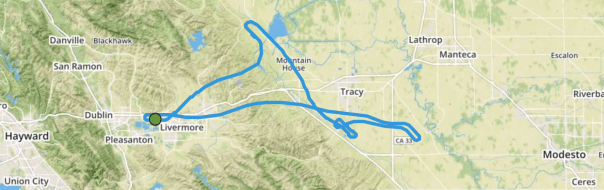
Lots of workout today. We did slow flight, approach to landing stall, power off stall in the clean configuration, power on stall, turns around a point, 8’s around pylons and two touch-and-go at Tracy before heading back home.
After refueling, I didn’t go through the checklist and couldn’t figure out why the engine would just not start. Turned out I had not enriched the mixture. Steve shouted it out simply based on how the engine sounded from the outside. 🙂
Starting up 737GM was a bit of a bear but chose to fly it this morning because 906MD’s carburetor was being re-worked due to starting problems. Tower cleared me for takeoff on 7L. Winds 130@5kts but quite variable.
Flight to Byron was quite straightforward and it was a good smooth landing. On the flight from Byron to Tracy, I had still been tuned to the Byron radio and I was wondering why Tracy traffic wasn’t announcing on the radio. I was still hearing Byron traffic. While in the pattern at Tracy, I saw an aircraft taking off and one waiting to take off and I had not heard either of them speak on the radio. It was only when I was nearing base turn in the Tracy pattern that I realized my mistake. Landing at Tracy was also good. I next proceeded to New Jerusalem where it was a bouncy touch and go. The flight back to Livermore was uneventful.
My brother-in-law was visiting us and I had asked Steve if we could take him on the next training flight. He had never been on a GA aircraft before. Steve’s first concern was that we may be close to the weight and balance limits and that the aircraft wouldn’t perform well with the load, making training a bit challenging. We decided to take him along for the next flight at 7:30am with the plan of one of us sitting out when he went on the flight. The weather was cool that morning, my brother-in-law wasn’t very heavy and Steve felt we could all ride along. He did let us know of emergency procedures and that he would take over the plane if such a situation occurred. We also checked to make sure that there were air sickness bags, if our guest needed it for his maiden flight in a small airplane. There were two at the ready but we never ended up using them. Normally we would climb at around 80kts but today with the load we couldn’t climb at more than 70kts.
First Srinath flew under the instrument hood.
Then he was introduced to steep turns (advanced performance maneuver). Steve demonstrated the first turn after he made clearing turns. We felt a bump at the 360° rollout of the turn. Steve explained this was our plane crossing our own wake turbulence (or is it wingtip vortex?). Srinath was looking at the instruments rather than outside to judge the angle. So Steve put a patch on the attitude indicator. Then Srinath did a turn on the left and one on the right. Here is a good cover story on slow speed flying as well as steep turns from AOPA’s Flight Training magazine.
Next was full stalls and recovery in the clean config. Power idle, pull back yoke, right rudder to maintain heading. Soon the stall warning horn goes off and there is the incipient stall when the plane buffets. Then the stall occurs when the nose drops. Relax the back pressure to allow airspeed to increase over the wings and produce enough light to break the stall. Wings level flight and then power to produce more lift back to straight and level flight.
Later, Steve introduced us to an approach to landing stall (at 2:27 in the video). At altitude, do clearing turns. Then run through a landing checklist as if you are going in for a landing. Lower airspeed and then flaps in standard increments. Then pitch up to enter the stall. Stall recovery is identical to the clean configuration. Once the power goes back up, turn off carburetor heat, raise the flaps gradually a notch at a time as if you are executing a go around. Raising the flaps too soon will cause the plane to lose lift too soon. Steve demonstrates this at 5:05 in the video. Losing lift too soon after recovering from a landing stall can be disastrous.
Wind was gusting from 220 up to 22kts at the Byron airport, coming down over the Livermore hills. So we decided to land at Tracy instead. Another pilot was landing at runway 8 just ahead of us. We ran into her at the airport terminal and she was getting endorsed to go on her first solo. Srinath and I exchanged places on the left seat. We decided to take off quickly to clear the area for her and after takeoff, wished her well with the solo. I did a couple of steep turns with Steve demonstrating what happens to the nose if it is not coordinated (4:09 in the video).
Finally for the day, we headed to New Jerusalem for three touch and go’s before heading back to Livermore.
 Crab Tales