Tag Archives: landings

N6475Q

N25ES has now been determined by the insurance assessor as a total loss and the club is in the process of finding a replacement 172. Steve was supportive when I asked if I could fly the club’s 1981 Cessna 152 (N6475Q) in the interest of staying in touch with my flying skills. I flew the 152 for the first time on July 24 to get a feel for the plane. I had not remembered to charge the batteries on my GoPro the previous night so there is no video archive from that first-time experience.

N6475Q is different from N25ES in many ways. For starters, it is a 2-seater aircraft (vs. 4-seat) and has a significantly lighter empty weight of 1165lbs (vs. 1459lbs). The plane is very sensitive to control inputs because of its light weight and the ride is also bumpier as it is easily tossed around by wind. The seats feel like they are almost at floor level with the legs pretty much extended straight ahead to the rudder pedals. I found it harder to get in and out of the plane. Seats slide front-to-back and the backrest has a single reclining position flopping flat on the seat in order to reach the luggage compartment. Front seats on the 172 have height adjustment, seat back reclining angle adjustment and they slide front-to back. The engine is a 115hp Lycoming 0-235 (vs. 180hp Lycoming 0-320 series). The most noticeable difference was during climb outs after takeoff due to the weaker engine. I’m used to a regular climb on the 172 but the angle of attack has to be much shallower on the 152 in order to avoid a power-on stall. Roughly 67-70 kts Vy for the climb (vs. roughly 76-80 kts) and 60 kts on the landing approach (vs. 65 kts). Right after takeoff, we needed to level off to gain airspeed before climbing out.

I’m flying 75Q today again and we did a bunch of touch-and-go at Livermore. Towards the end we were switched to runway 25L and on the last approach, I was way too high and too fast so I did a go-around and requested tower to switch us to 25R for a full-stop.
Flaps + Power = Flower

A couple of days ago on June 30 we did a bunch of landings at Livermore. All them were decent or better, with one of them very good that Steve didn’t feel compelled to give me any instructions.

We started today with steep turns, power-off stall and then a simulated engine-out landing at Byron. On this approach we had quite a bit of altitude to lose. We tried a slip but that didn’t bring us down much because of headwinds. Then we tried S-turns to lose altitude. After 4 landings, we decided to head to New Jerusalem. It was a warm and cloudy day. The density altitude at Tracy was reported as 1600′. Reflecting on the landings at Byron I suggested that maybe extending downwind would have made it easier to land. Steve was emphatic (7:34 into the video) that that was not only necessary but it will provide more opportunities to botch a landing.

On the first landing at New Jerusalem, I came down hard and bounced up quite a bit. I didn’t react quickly so Steve shoved in the throttle (8:24) and did a go around. Rightfully he gave me an earful. The second landing was ok – flared up a little too much but was able to bring the plane down just fine. After two more good landings, Steve endorsed me to fly solo.

It was unnerving to hear Steve ask me to fly solo but once I got into the cockpit and started the preparations, all such nervousness dissipated. During the flight there was so much to mentally manage that there was no time to feel nervous. I felt ready to handle it with all the training I’d received. The first landing was alright but on the second landing I bounced. And bounced high. Thankfully Steve’s words must have stuck in the back of my mind because I immediately pushed the throttle forward and did a go-around. The nose wanted to point way high up with full flaps deployed for the landing and I remember pushing forward hard on the yoke to fly nearly level and build up airspeed before climbing and slowly retracting the flaps a notch at a time. Perhaps I came in too fast and too flat causing the serious bounce. Since I did a go-around, I decided to do two more landings for a total of 4. They were not great but I managed to make them stick. The rest of the flight back home was uneventful.

This unfortunately ended up being my last flight on N25ES. In the following week another member of my flying club flew the plane and while practicing touch-and-go at Livermore bounced hard on a landing. The plane porpoised but the pilot did not attempt a go-around expecting to salvage the landing. The nose gear touched down first and the prop stuck the tarmac. The pilot was fortunately alright. He was a low-time pilot (having recently earned his private pilot’s license on the Cessna 152 and only a couple of hours of experience on the 172) and didn’t realize the seriousness of what had just happened. He did a few more touch-and-go before calling it quits. Later inspection revealed that the tip of one prop had broken off and the firewall had buckled. The plane ended up as a total loss and an insurance claim. The club has started a search for a replacement 172.

PS: In case you are wondering about the title of this blog, check out (9:37) into the pre-solo video.

More landings

I’m finally starting to get the hang of landings.

Today the winds were from 280 @ 6kts and the controller cleared us for right closed traffic on runway 25R. We were #2 behind another inbound aircraft and I started off being too flat on the landings. On one of the early landings, I ballooned up due to too much flare too soon and Steve pushed the power in to do a go-around. We were then #2 behind a Beechcraft Baron and the tower changed us from 25R to 25L and left closed traffic. After a landing, the tower gave us the option to switch back to 25R which we gladly took.

After a few landings and one real greaser, Steve took the plane just to give me a breather. He did a short approach to hand the plane back to me quickly for more touch and go’s. I did another greaser landing and the controller switched me to 25L promising to switch me back to 25R after one pattern. But soon the controller came back on the radio and asked us to follow a LearJet to 25R. We called it quits after that final landing.

Touch-and-go at Livermore

We started a right closed traffic pattern at Livermore around 5:45pm and there was quite a bit of air traffic in the area. The landings were all below average but it was good to get some experience dealing with the traffic. I’m still trying to figure out the flare just before touchdown. By the time I came around for the fifth landing, the traffic was pretty much gone. My radio work was quite shabby. In fact, I could chalk this video up as Radio Bloopers.

One time we were cleared to land but on final the tower asked us to go around – presumably the traffic behind turned out to be faster than the controller initially thought. On the next approach, I flared a little too much and I ballooned up a little too much just above the runway. So I immediately did a go-around without prompting from my instructor.

Just before we ended for the night, Steve asked the tower controller to show me light gun signals. We saw a Green flash and then a Red flash. Technically, this means “Exercise Extreme Caution“. A steady Green would have cleared us to land instead. We landed anyway because our radios were still working and we got clearance from the controller who showed us the light gun signals.

Another first night cross country

Tonight I flew my first night cross country. Days were long being we were close to summer solstice so we agreed to meet Steve in the hangar at 9pm. After pre-flight we were anticipating a takeoff around 9:30pm (which would have made it a true night flight) and arriving back in Livermore close to midnight. The route was Livermore (KLVK) to Hollister (KCVH) to Gustine (3O1) and back to Livermore. I’d filled out my cross country checklist, listened to 1-800-WX-BRIEF and captured notes for preparation.

The departure route was to follow I-580 and then I-680S but instead we took off from 25R, turned left crosswind and decided to cut across over Mission peak to I-680. Winds were from 260 @ 9kts which was a direct crosswind on our course. Consequently we didn’t climb very well and the airspeed was only 65kts which bothered us. So we banked to the right into the wind to gain altitude. Thanks to ForeFlight on our iPad in the cockpit, we were able to identify a FedEx and a VirginAmerica jet that crossed our paths. In fact, we even felt a slight bump (turbulence) from the FedEx’s wake turbulence as we crossed its path about 2000′ lower.

Once we crossed over Mission Peak, we stayed just west and parallel to the foothills since further west would put us in the approach path for flights into San Jose (SJC). South County airport was in sight and would have been a likely location to land if we ran into any emergencies. US 101 was also beneath us and as we neared Hollister, Hwy 152 was another emergency landing option. Although, it was backed up with traffic and police cars flashing lights. We landed straight into Hollister and then flew a right pattern out and to the east towards Gustine.

Hollister to Gustine tracked us over dark no man’s land. Steve wanted me to closely follow Hwy 152 since we were flying over hilly terrain and a large reservoir. Gustine was a little bit hard to find, but not as hard as finding Kingdon when Srinath flew his night cross country last month. I had remembered the airport was just past I-5 on the eastside and keying the mike turned on the runway lights making it possible to spot. However I had gained quite a bit of altitude so we decided to fly around the airport to lose altitude, and also to note the state of the windsock. We couldn’t see it clearly but it appeared there were no winds. So I decided to land on Rwy 36.

The approach was not great. I was too high and not well lined up so I decided to go around. This time Steve was able to confirm that the windsock was limp. No winds to speak of. On the downwind leg it seemed that I was not parallel to the runway and that might be why I had trouble with the last approach. This time I managed to land but it was a bad one – we bounced.

The last leg back to Livermore was mostly uneventful. We followed I-5 up to Tracy and then cut across over Altamont pass. The night was so cool and the flight so smooth (except for a little bit of wind turbulence as we approached Tracy) that Srinath fell sound asleep in the back seat.

Crosswind landings, stall recovery under instruments

We started off with Steve handing me stylish eyewear i.e. flying under the hood. After maintaining a heading and then tracking a VOR, I practiced two stalls in the clean configuration and recovery. Using only instruments under the hood. Then I practiced an approach to landing stall. First by initiating a descent, slowing down to 1500rpm and deploying flaps. The idea is to simulate a landing approach. Then pulling up the plane in this configuration and initiating a stall the plane. Recovery is similar to a stall in the call configuration with the exception that we have flaps deployed. So slowly retract flaps step by step when a climb has been achieved.

Next, I practiced slow flight with shallow turns. And then Steve pulled the power out simulating an engine out situation. We scouted a field and when we got pretty low, Steve pushed the throttle and we headed over Byron.

The winds were really strong at 20kts but fortunately it was a headwind on Rwy 23. Still the ride was really bumpy, perhaps the bumpiest of all our flights thus far. We practiced a couple of touch-and-go and then headed to Livermore for a couple more.

On the second touch and go at Livermore, we ballooned after touchdown due to the wind so Steve immediately did a go-around. I wasn’t quick enough to react and this was a good learning experience. After one more landing, we called it quits for the day.

Wings of Freedom

The annual Wings of Freedom Tour is going on this weekend at the Livermore airport. As we pulled up beside our hangar, a B-17 Flying Fortress “Nine 0 Nine” was going through its run up check prior to takeoff. The Collings Foundation offers tours on its fleet of WWII aircraft as they tour around the country. The sound of its Wright-Cyclone engines thumped through the air and echoed off the nearby hills. Our hangar is one of the closest to the run up area and a group had gathered for best views and to photograph the spectacle.

We took off on 25R and headed right downwind. As we were climbing, Steve spotted a B-25 on our right heading towards the airport to perform an overhead break. Very soon Steve handed me stylish eyewear, his term for the instrument hood. After maintaining different headings, Steve asked me to stall the plane. Under the hood! Without realizing, I ended up in a falling leaf stall so I did it again, this time consciously and without the hood. The plane was clearly unhappy as it bounced around in a stall condition.

Today we tried boxing the sky for the very first time. Using full rudder to move the nose to the left and right while at the same time using the ailerons to keep the wings level. After a few boxes, we headed to the New Jerusalem airport. It was pretty close by and we had quite a bit of altitude to lose so we did a side slip with nose slightly nose down and fully cross controlled. We did 5 touch-and-go at New J before heading back to Livermore.

As we got close to Tracy to turn west towards Livermore, the B-17 passed ahead of us and we followed it all the way to Livermore. He was lower so we didn’t have any threat from wake turbulence. We did watch where he landed so we could touchdown farther to avoid the wake turbulence on the runway. The bombers were done for the day and we taxied past them on our way to fuel.

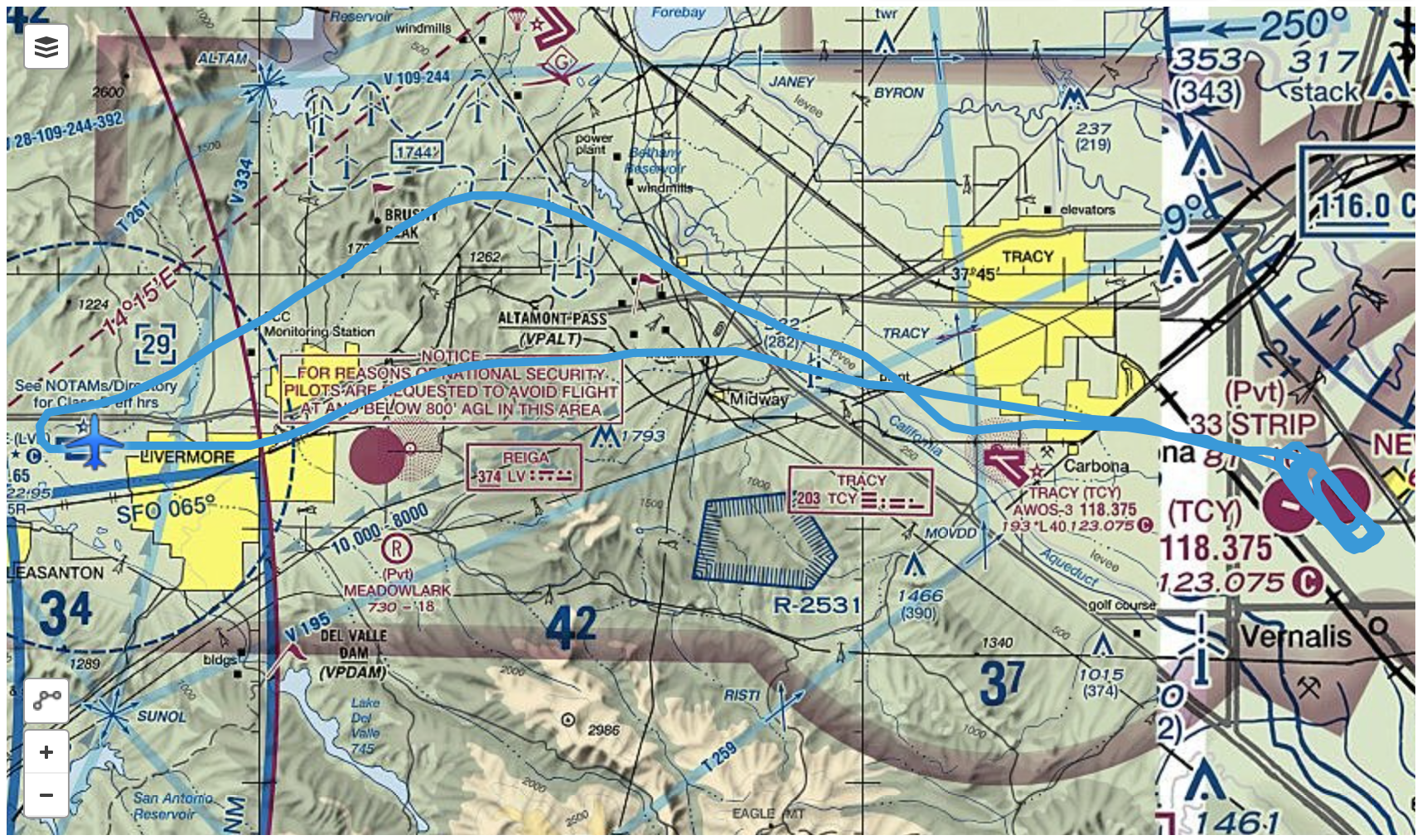
had never seen these WWII aircraft in airworthy condition, let alone flying or taxiing amidst these heroes. Today was a memorable day! Here is the full flight track for the day.

More landing

Steve felt I really needed more practice with landings – they were pretty bad on sunday due to infrequent flying. So we planned to touch and go at Byron. However the winds were not calm (from 230 at 10, gusting 15). So we rerouted for Tracy (350 at 7kts) but runway 12/30 has been significantly shortened and more importantly, 8/26 has been completely taken out for re-paving! We decided to re-route to New Jerusalem. Two landings and the third was a go-around since the approach was not good. In between, Steve demonstrated a short field landing and takeoff. Overall, I owed him $16.50 if you counted $0.50 for each “right rudder” prompt.

Today was the first time I used a second GoPro in the cockpit. I had it pointing to the right, suction mounted on the rear window. With the engine under any power, the vibrations were too much and readily picked up by the GoPro. I need to find a better mounting location.

Screen Shot 2015-06-11 at 8.24.14 PM