Tag Archives: New Jerusalem

Wings of Freedom

The annual Wings of Freedom Tour is going on this weekend at the Livermore airport. As we pulled up beside our hangar, a B-17 Flying Fortress “Nine 0 Nine” was going through its run up check prior to takeoff. The Collings Foundation offers tours on its fleet of WWII aircraft as they tour around the country. The sound of its Wright-Cyclone engines thumped through the air and echoed off the nearby hills. Our hangar is one of the closest to the run up area and a group had gathered for best views and to photograph the spectacle.

We took off on 25R and headed right downwind. As we were climbing, Steve spotted a B-25 on our right heading towards the airport to perform an overhead break. Very soon Steve handed me stylish eyewear, his term for the instrument hood. After maintaining different headings, Steve asked me to stall the plane. Under the hood! Without realizing, I ended up in a falling leaf stall so I did it again, this time consciously and without the hood. The plane was clearly unhappy as it bounced around in a stall condition.

Today we tried boxing the sky for the very first time. Using full rudder to move the nose to the left and right while at the same time using the ailerons to keep the wings level. After a few boxes, we headed to the New Jerusalem airport. It was pretty close by and we had quite a bit of altitude to lose so we did a side slip with nose slightly nose down and fully cross controlled. We did 5 touch-and-go at New J before heading back to Livermore.

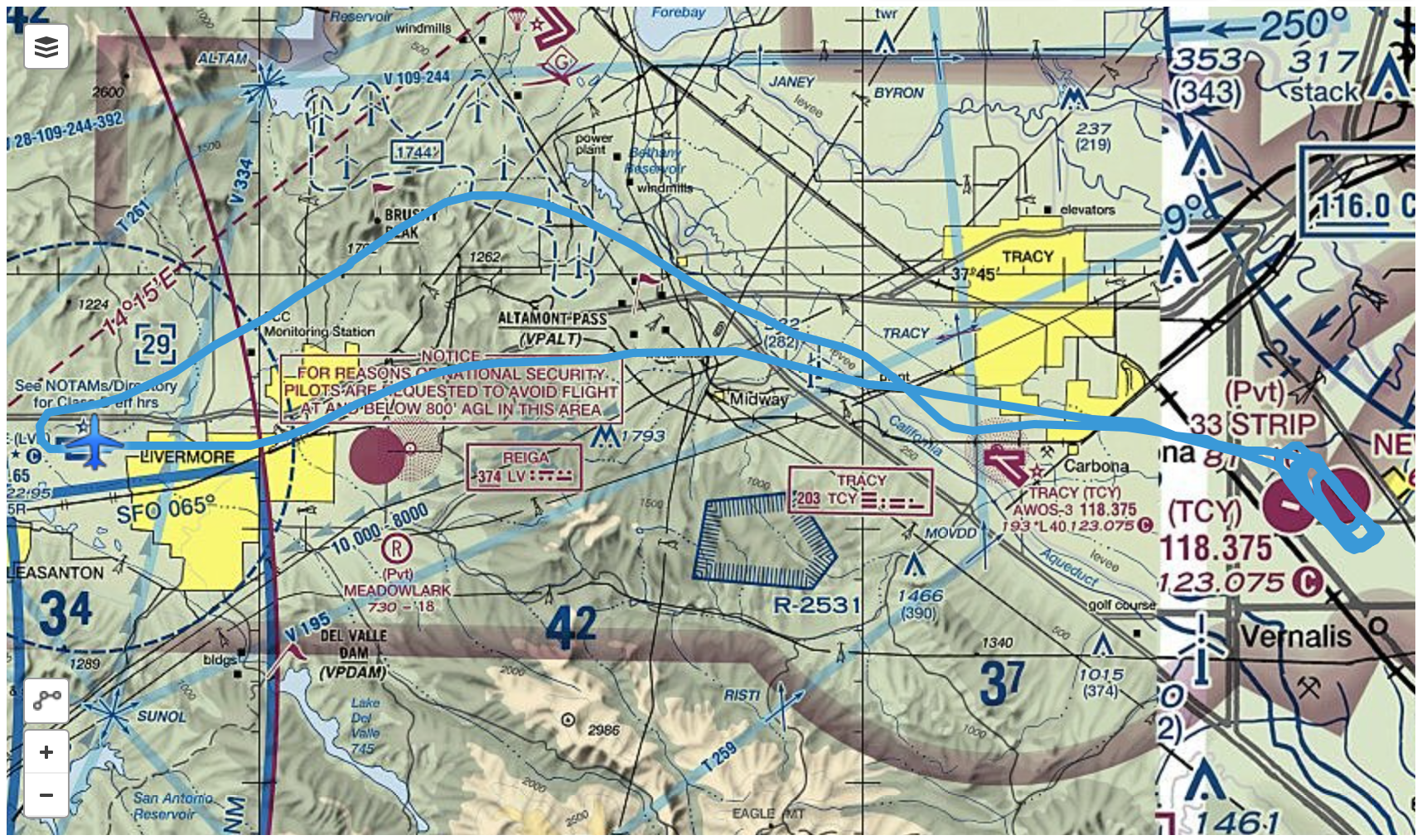
As we got close to Tracy to turn west towards Livermore, the B-17 passed ahead of us and we followed it all the way to Livermore. He was lower so we didn’t have any threat from wake turbulence. We did watch where he landed so we could touchdown farther to avoid the wake turbulence on the runway. The bombers were done for the day and we taxied past them on our way to fuel.

had never seen these WWII aircraft in airworthy condition, let alone flying or taxiing amidst these heroes. Today was a memorable day! Here is the full flight track for the day.
More landing

Steve felt I really needed more practice with landings – they were pretty bad on sunday due to infrequent flying. So we planned to touch and go at Byron. However the winds were not calm (from 230 at 10, gusting 15). So we rerouted for Tracy (350 at 7kts) but runway 12/30 has been significantly shortened and more importantly, 8/26 has been completely taken out for re-paving! We decided to re-route to New Jerusalem. Two landings and the third was a go-around since the approach was not good. In between, Steve demonstrated a short field landing and takeoff. Overall, I owed him $16.50 if you counted $0.50 for each “right rudder” prompt.

Today was the first time I used a second GoPro in the cockpit. I had it pointing to the right, suction mounted on the rear window. With the engine under any power, the vibrations were too much and readily picked up by the GoPro. I need to find a better mounting location.

Screen Shot 2015-06-11 at 8.24.14 PM

Training after quite a break

Starting off with slow flight and shallow turns, then a stall in landing configuration. But first, clearing turns first on the right, then the left. We heard the ATC tell another pilot in the area that we were about a mile west of New Jerusalem and that we were doing some maneuvers and 360 turns.

Then an engine out simulation. We went through the checklist before finding a place to land.

Turns around a point, both right and left, a couple of miles from New Jerusalem. There were two adjacent fields with crop circles which made it somewhat manageable visually although right turns were harder than left due to lack of sight picture. [This part was edited out of the video]

We were going to practice touch and go at New Jerusalem but then we had a unique experience. As we approached the airport we spotted stuff on the runway. We planned a fly over to identify what it was. The runway had an X on it meaning it was closed and there were containers on the runway. Steve guessed it was probably Myth Busters doing something at the runway.

So we headed for Tracy instead. First taste of cross wind landing at tracy. Winds from 240 @ 9kts and we aimed to land on Rwy 30. Left wing down for takeoff and right rudder. The airport has a tetrahedron to indicate wind direction. After a few landings, we headed back to Livermore.

First go-around

Slow flight and shallow turns to the right and left. Power off stall and recovery. Then simulating an engine out emergency. First, trim for a glide attitude for a speed of 65kts. Then attempt an engine restart by (1) checking that the fuel selector valve is on both, (2) mixture is rich, (3) carburetor heat is ON, (4) throttle is cracked open, (5) ignition switch is on BOTH, (6) primer is IN and locked in place. Start the engine if the propeller is stopped. If all of that fails…

Quickly scout for a place to land with wind direction in mind. In this case we were in the vicinity of New Jerusalem airport so we are going to try to land there. No wind today so we aim for Rwy 30. We were high so Srinath used a slip to get down quickly. In the case of an electrical failure the flaps won’t work so slips are a good technique to learn. After a couple of landings, Steve said there was a cow on the runway so Srinath did a go-around. A few more landings at New Jerusalem and then back to Livermore for a straight in landing.

More high air work

We were heading towards New Jerusalem and had entered the hills east of Livermore. Steve suddenly pulled the power (engine out simulation) and asked Srinath what he would do. Srinath suggested checking the fuel gauges (wrong), restarting the engine (wrong). Then he was scouting for a location (wrong). We were losing altitude and the terrain beneath us was climbing so the first thing to do was to turn 180 and head out of the hills back to the valley from which we approached. Steve took over the plane, made a steep turn to the left 180 degrees and got us pointing out of the hills towards the Livermore valley. This way we have increasing altitude under us. Then we scout for a place to make an emergency landing. We had a couple of back roads and some green fields and that was it. The exercise was over, we put the throttle back in, turned 180 and headed back into the hills, aimed for the valleys since we were still climbing slowly and again wanted more altitude underneath us.

Later, we headed towards New Jerusalem for steep turns, slow flight. When making turns in slow flight, look at the turn and bank indicator to make sure the turn isn’t steep. Don’t go beyond the first notch. Next, stall in the landing configuration – Steve demonstrated why you don’t dump all the flaps at once. We lost lift and descended at about 2000′ a minute even though the engine was powered up. Of course, this can be serious when you are close to the ground and starting a go-around.

Finally, some landings at New Jerusalem and then back to Livermore.

More Landings

Trying to make up for the last month when we couldn’t schedule even a single lesson.  This week is turning out to be all about landings. It is Srinath’s turn to fly today. Flight service gave us a bird advisory in the Livermore airport vicinity – first time I’ve heard this. We flew south of R-2531 after a left downwind departure from Livermore since the restricted area was in effect today being a weekday. This time we looked for landmarks that we had studied in the sectional chart last sunday.

A the end of two attempts at slow flight, we were at 3000′ and the aircraft and almost right above the New Jerusalem runway. So Srinath put the engine in idle, looked for 65kts glide speed and we circled once to lose altitude before going in for the first landing. On the second landing, Srinath took his hands off the throttle so Steve immediately put in full power for a go-around. Srinath did a total of 5 landings and one go-around at New Jerusalem, Steve did one landing to show Srinath. Then Srinath did a 6th straight-in landing back at Livermore.

[Aug 14] Steve and I both have a hard stop in the morning so we decide to shoot landings at Livermore airport itself. We start at 7:30am and get 13 landings in an hour before calling it a day.

9 Landings

We traveled to see the Grand Canyon NP right after the previous flying lesson. By the time we came back, Steve was on vacation for a week. The following week he was in town but we couldn’t arrange a suitable time with him. Then he went to the EAA’s OshKosh Airventure for a week. We finally managed to fly again today after just over a month since the last lesson.

First for some refresher on the charts (Section and TAC). The plan was to fly to New Jerusalem and practice landings. Steve told us how to find New Jerusalem based on the charts and then he pointed out a restricted area R-2531 just to the southwest of Tracy airport. The landmarks were a tall tower on the east side of the restricted area and a road that runs to the south of the area. They didn’t operate the restricted area on weekends so it was OK if we inadvertently few over it – well, OK we did it on purpose, not inadvertently.

Steve didn’t want me getting too comfortable with right downwind departures from KLVK so this time we decided to take off from 25R on a left downwind departure. A few minutes into the flight, the controller announced there was another airplane at 11 O’clock heading towards us at 3800′. We were at around 3000′. By the time we spotted, it was a couple of hundred feet above us. Since we were climbing, I temporarily leveled the plane until we crossed each other before resuming the climb.

20140814-194112-70872984.jpg

There was nobody at the New Jerusalem airport where we headed for touch and go’s. I did 8 landings of which I pulled off one of them without Steve having to touch the controls. In general, the landings were hard because I haven’t figured out how high I’m above the runway. When I thought I was inches above, I turned out to be about 10 feet above. We then returned to Livermore for the 9th landing of the day which was a straight-in approach.

Steep turns, instrument hood, stalls, touch-and-go

My brother-in-law was visiting us and I had asked Steve if we could take him on the next training flight. He had never been on a GA aircraft before. Steve’s first concern was that we may be close to the weight and balance limits and that the aircraft wouldn’t perform well with the load, making training a bit challenging. We decided to take him along for the next flight at 7:30am with the plan of one of us sitting out when he went on the flight. The weather was cool that morning, my brother-in-law wasn’t very heavy and Steve felt we could all ride along. He did let us know of emergency procedures and that he would take over the plane if such a situation occurred. We also checked to make sure that there were air sickness bags, if our guest needed it for his maiden flight in a small airplane. There were two at the ready but we never ended up using them. Normally we would climb at around 80kts but today with the load we couldn’t climb at more than 70kts.

First Srinath flew under the instrument hood.

Then he was introduced to steep turns (advanced performance maneuver). Steve demonstrated the first turn after he made clearing turns. We felt a bump at the 360° rollout of the turn. Steve explained this was our plane crossing our own wake turbulence (or is it wingtip vortex?). Srinath was looking at the instruments rather than outside to judge the angle. So Steve put a patch on the attitude indicator. Then Srinath did a turn on the left and one on the right. Here is a good cover story on slow speed flying as well as steep turns from AOPA’s Flight Training magazine.

Next was full stalls and recovery in the clean config. Power idle, pull back yoke, right rudder to maintain heading. Soon the stall warning horn goes off and there is the incipient stall when the plane buffets. Then the stall occurs when the nose drops. Relax the back pressure to allow airspeed to increase over the wings and produce enough light to break the stall. Wings level flight and then power to produce more lift back to straight and level flight.

Later, Steve introduced us to an approach to landing stall (at 2:27 in the video). At altitude, do clearing turns. Then run through a landing checklist as if you are going in for a landing. Lower airspeed and then flaps in standard increments. Then pitch up to enter the stall. Stall recovery is identical to the clean configuration. Once the power goes back up, turn off carburetor heat, raise the flaps gradually a notch at a time as if you are executing a go around. Raising the flaps too soon will cause the plane to lose lift too soon. Steve demonstrates this at 5:05 in the video. Losing lift too soon after recovering from a landing stall can be disastrous.

Wind was gusting from 220 up to 22kts at the Byron airport, coming down over the Livermore hills. So we decided to land at Tracy instead. Another pilot was landing at runway 8 just ahead of us. We ran into her at the airport terminal and she was getting endorsed to go on her first solo. Srinath and I exchanged places on the left seat. We decided to take off quickly to clear the area for her and after takeoff, wished her well with the solo. I did a couple of steep turns with Steve demonstrating what happens to the nose if it is not coordinated (4:09 in the video).

Finally for the day, we headed to New Jerusalem for three touch and go’s before heading back to Livermore.