I’m flying with Steve today on dual instruction. As we climbed out of Livermore, I noticed deteriorating visibility which I assumed was a cloud layer. Steve pointed out that it was actually smoke from a very large wildfire burning near Big Sur on the California coast. On the east side of the Livermore ridge the conditions were a little better, enough for us to continue with a training flight after having had thoughts along the way of possibly turning back.
At 3000′ the smoke layer wasn’t bad so I did steep turns on the right and left. Still not very comfortable doing steep turns. Steve demonstrated a turn which was fairly steep and he might have pulled up to keep the nose from dropping and I was not comfortable with the associated sensations.
Next we did slow flight and then a few different stalls – power off stall in the landing configuration, power-off stall on a right turn and then a power-on stall.
We went through a routine engine out simulation and at the end of it we spotted the pipeline and transitioned into S-turns. At that time I spotted another aircraft which was also flying at our low altitude seemingly also using the pipeline for making S-turns. We watched it for a while as it appeared they were leaving the area but then they really didn’t. After one turn we decided to leave the area and do turns about a point at a nearby location.
Lots of traffic everywhere today. As we were approaching Byron and announced our position over Discovery Bay, another aircraft was taking off and was going to do a 270 en route to Livermore. That would put it coming straight at us at comparable altitude. Radio communications helped save the day with each other knowing our locations.
There were gliders flying today at Byron and there was unexpected thermals as we approached the threshold for Rwy 30 that caused me to stay up longer even though I had pulled out the power on the engine. Two touch and go and we headed back to Livermore.
Planned to fly at 8am but ceiling was quite low – Marginal VFR. Pushed it out to 9am but weather was no better according to METAR. Steve said it was good enough to fly on the other side of the ridge. The METAR said ceiling was 1500′ but we saw other planes fly the pattern altitude around the Livermore airport and there was plenty of clearance. The METAR only looks at the sky above the tower where they typically take the readings. After takeoff, we stayed just about 2000′ flying to the right of brushy peak but not that much higher than its summit. On the other side in the valley, ceiling was greater.
Lots of workout today. We did slow flight, approach to landing stall, power off stall in the clean configuration, power on stall, turns around a point, 8’s around pylons and two touch-and-go at Tracy before heading back home.
After refueling, I didn’t go through the checklist and couldn’t figure out why the engine would just not start. Turned out I had not enriched the mixture. Steve shouted it out simply based on how the engine sounded from the outside. 🙂
Today the winds were calm and clouds were 4900′ scattered. As we taxied out, we noticed that the construction of Three Rivers FBO is making good progress and they are getting ready to open by Super Bowl. The new fuel station has been opened and the old one removed. Miraculously, the intercom in the back seat of N906MD has been fixed! We no longer need an intercom extender and people in the front seats can hear the person in the back.
We headed to Byron and made steep turns in the vicinity of the airport. Upon rolling out of the steep turn, use opposite rudder to stop the turn. Then Srinath practiced slow flight followed by three kinds of stall. First, power-on (departure) stall. Upon reaching stall, just relax the back pressure on the yoke. Because it is a power-on stall, the engine is already running pretty hard so relaxing the yoke should cause it to recover quickly. If you shove the power in, more altitude will be lost before recovery. It is only in a power-off stall that once recovery is achieved with relaxing the yoke that the power should be shoved in.
Power-off stall was next, followed by an approach to landing stall. Start with a pre-landing checklist, then come back on the power to extend full flaps while within the white arc. Achieve a descent as if we are coming in for landing. Then pull back to stall. Recovery is the same as a power-off stall – relax the yoke to drop the nose and build up airspeed then shove full throttle. So we went through all varieties of stalls today.
Steve pulled back the throttle to simulate an engine out situation. The ABC checklist comes in handy here – Airspeed, Best place to land, Checklist to attempt restarting the engine. It is important to achieve and maintain the airspeed for best glide. On the 172 that is 65kts. Then you determine the direction of wind and scout for the best place to land. Preferably you land into the wind. In our case we found a restricted runway which of course would have been fair game in the event of an emergency. Keep the runway in view all the time as you weave around and descend. If there was no runway, look for a hard field or green field but certainly not one that is wet or just recently plowed. Land along the furrows if there are any.
We proceeded to a long pipe in the vicinity, descended to 800′ AGL and made S-turns by entering downwind. The first maneuver was intended to watch for the wind and the right turn ended up being too shallow because the wind pushed us into the turn. On the next attempt Srinath proceed a little further ahead before attempting the turn. He could also have tried a shallower right turn so the wind pushing us back would have made it a fine semicircular turn.
Finally Steve asked Srinath to use the GPS to take us directly to Byron. He landed by making a right base turn and after touchdown Srinath tried maneuvering the plane to get on the centerline which Steve reminded him never to do so for the risk of getting into a ground loop. Just staying parallel to the runway is sufficient. Srinath took off with a soft-field technique. Once the nose comes up off the “dirt”, shove in full power to maintain the nose slightly off the runway until the plane lifts off. Then push the yoke forward to stay in ground effect to build up airspeed before climbing out.
Finally, maximum performance takeoff. Stand on the brakes and shove the throttle fully in. Watch the RPM come up to 2200 and then release the brakes. Plane will race forward rapidly. Maintain control and at 60kts, pull back on the yoke to climb at Vx until a “50-foot obstacle” has been cleared. Then relax the back pressure to build up airspeed and climb at Vy. After a pattern, Srinath did a precision landing on the numbers. One more maximum performance takeoff followed by a 270 turn to overfly midfield before heading back to Livermore.
A bit of drama on the way back to Livermore. Our radio didn’t connect well and we barely heard the tower transmission after we reported our position over Brushy Peak. Tower asked another aircraft in the vicinity to check if we could hear them. In the meantime, because of this, Steve took us on a 360 right turn to maintain position over Brushy Peak while we re-established connection. A mooney was taking off from Livermore and heading in our general direction, which is probably why Steve did the turn. We were soon cleared in to land on runway 7L.
The Flying Particles club has added a new 1976 Cessna 172N Skyhawk. Unlike N25ES which was owned, the club has leased N906MD from Pete Sandhu at Five Rivers Aviation, LLC who is going to soon open and operate a new FBO out of the Livermore airport. 6MD has the same 180hp Lycoming 0-320 Series engine as 25ES but it is equipped with Garmin GNS-430 GPS.
Srinath flew 6MD today and it has been almost 3 months since Srinath last flew. His last flight was the solo on May 28. So he went back to brushing up on air work – power off stalls, stalls in the landing configuration and power-on stalls. Then we did an engine out simulation and after a couple of landings at Byron, we returned to Livermore.
We started with an engine out simulation as we were climbing on downwind leg out of Livermore. Steve explained why we couldn’t go back to Livermore – because of headwinds if we turned towards the airport. After scouting a place to land, we quickly pushed the throttle back in and climbed on.
After we crossed the hills east of Livermore, Srinath tried three power off stalls. On the second one, the stall wasn’t fully reached before recovery and that is clear from the video where the nose didn’t quite drop.
Next, Steve showed us something new [2:55 into the video]. He forced a stall and instead of relaxing the back pressure as we usually do to break the stall, he kept it all the way back. So the plane continued to be stalled. One of the wings (left) dropped and without using the ailerons, used only the rudder to pick up that wing. [In the audio, Steve misspeaks about the right wing being down and using the right rudder to compensate]. Then he asked Srinath to hold the elevator all the way back and use only the rudder. He later mentioned that it was called the Falling Leaf Stall.
I needed to research this maneuver because we didn’t discuss it further that day with Steve. It turns out to be an uncommon high air work and found this article in the AOPA Flight Training magazine from 1998. In short, by keeping the wings level this maneuver makes the plane resemble a falling leaf. As the wings rock, it is picked up by using opposite rudder. In a stall, the ailerons have very little to no authority. The rudder is above the turbulent air flow washing off the wings and hence still has authority allowing the yaw to compensate for dropping wings.
We got to about 2000′ MSL and we ended the maneuver by breaking the stall and powering up the engine. Next was turns around a point and then figure 8 turns. Winds were from 220 at 21kts so that certainly made the ground references challenging.
We proceeded to Byron. Winds were from 220 at 22 gusting 29. It has been the most sustained turbulence we have experienced thus far in training. Srinath suggested we’d land on Rwy 30 which was the wrong choice. So Steve decided to give us an education by attempting the landing and then doing a go-around when the full rudder deflection wasn’t sufficient. The plane was visibly crabbed at an extreme angle and that was still insufficient for the launch. After the go-around, Srinath did two landings on Rwy 23 before heading back to Livermore for a landing well after sunset.
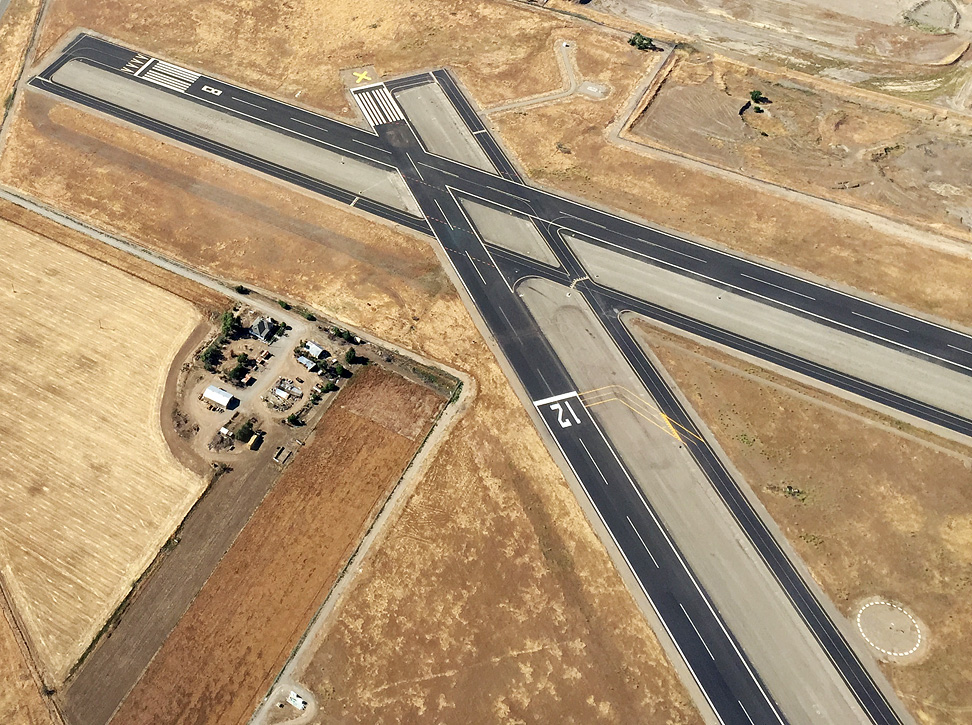
Steve gave us a heads-up that we will fly over the Tracy airport so we can see some changes for ourselves. The runways were getting a makeover aka resurfacing. The threshold for Rwy 12 has been relocated so that Rwy 8/26 can be reconstructed. So the usable portion of 12/30 is now significantly shorter. Taxiways had been redrawn.
Next, Srinath had a chance to practice slow flight and shallow turns and a power-off stall. He lost just a couple of hundred feet during recovery. Next was ground reference maneuver – turns around a point. Today the sight picture beneath us was a rectangular area as opposed to a crop circle as we’ve seen before. Finally, a few cross-wind landings at New Jerusalem before heading back to Livermore.
Slow flight and shallow turns to the right and left. Power off stall and recovery. Then simulating an engine out emergency. First, trim for a glide attitude for a speed of 65kts. Then attempt an engine restart by (1) checking that the fuel selector valve is on both, (2) mixture is rich, (3) carburetor heat is ON, (4) throttle is cracked open, (5) ignition switch is on BOTH, (6) primer is IN and locked in place. Start the engine if the propeller is stopped. If all of that fails…
Quickly scout for a place to land with wind direction in mind. In this case we were in the vicinity of New Jerusalem airport so we are going to try to land there. No wind today so we aim for Rwy 30. We were high so Srinath used a slip to get down quickly. In the case of an electrical failure the flaps won’t work so slips are a good technique to learn. After a couple of landings, Steve said there was a cow on the runway so Srinath did a go-around. A few more landings at New Jerusalem and then back to Livermore for a straight in landing.

 Crab Tales