Last week I called my DPE as previously discussed and got a cross country from KLHM to KMRY for planning. Also, I got the weight and balance details which I worked out in advance. Otherwise, I was asked to prepare per the ACS.
I arrived at Lincoln last evening and stayed overnight. Lincoln airport charges a $5 transient parking fee for overnight tie down. You can pay at the self-service box on the ramp. You can get an Uber from the airport to one of the local hotels. I had tried calling the airport twice to find out the availability of courtesy cars but only reached their voicemail.
My checkride started this morning at 9am. I met the DPE at their hangar. DPE wanted to start off by understanding how I got into flying and what I expected to do with the license. Since I’m interested in volunteering, DPE suggested I go a step further and see if I could work with companies who need photographers/pilots (eg. Sierra Pacific, US Fish and Wildlife). A commercial license will be helpful in that case.
After a few minutes, we started by reviewing and signing my IACRA online, reviewing identification documents, knowledge test, pilot and medical certificates and the pilot logbook for all the necessary endorsements. Next, I was asked to show how the aircraft is ‘qualified’ for our flight today. I went through the annual for airframe, engine and propellor, reviewed the ADs that have been completed with our 50-hr inspections. We had a discussion around whether or not our planes need a 100-hr inspection considering our club is owner-operated. These planes are not considered ‘for-hire’ for flight training (because the instructors are paid directly and they are not employed by the club). DPE explained that especially for today’s checkride, since it is not flight training we don’t need a 100-hr inspection. We talked about always logging accidents and incidents with the NASA Aviation Safety Reporting System and the associated form at the back of FAR/AIM (on page 1127 in the 2018 edition).
The oral exam was a combination of scenario based and direct questions. DPE let me refer materials (I had all the handbooks and manuals on my iPad) whenever needed and occasionally even pointed out specific sections in documents to refer.
First scenario was that of a private pilot taking friends to Monterey who offer to pay for the trip. Upon landing at Monterey, FAA agent does a ramp check. We talked about this at length, including ADM, hazardous attitudes, PAVE checklist especially external pressures since friends are involved. We also discussed IMSAFE and personal minimums. It helped in the discussion that I had one already filled out. A variation on the scenario was that I had flight following but my radios died before entering Monterey class Charlie. What would I do next?
We looked at weight and balance for the aircraft. I was asked to explain how I know if it is still valid.
If placards have faded, is the aircraft still fit to fly?
We had a discussion around inoperative equipment. How do we know if fuel gauge isn’t working and would we fly with such a gauge? How about a failed attitude indicator? How should we deal with inop equipment? Then we went on to minimum equipment list, equipment list from the POH listing required equipment, A TOMATO FLAMES checklist.
Know the ADs for your aircraft, when they were complied with and in the case of recurring ADs the frequency at which to inspect.
Then we had a detailed discussion of the electrical system and fuel system. What if either the alternator or battery fails during flight. A related question was why the alternator generates 14V when the battery is only rated for 12V.
Next we reviewed the cross country plan and discussed the route, altitude choices, airspaces along the way, requirements for the airspaces, special use airspaces and their requirements, flying over water and class Bravo considerations. If the cross country was planned at night what I would do differently, do I need oxygen. Requirements for flying under class Charlie shelf and over class Delta. DPE liked the fact that I had the plan on Foreflight/iPad as well as a written cheat sheet with landmarks, headings and ETA.
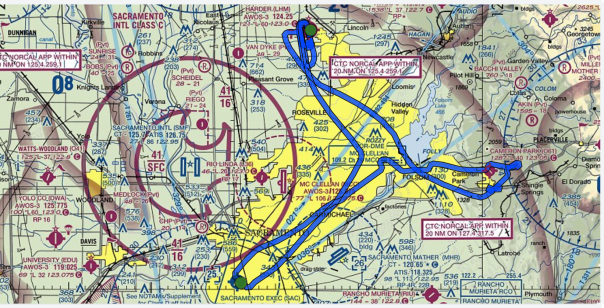
We took a break before starting on the flight portion of the test. DPE said I can take all the time I needed to adequately set up for each maneuver. Flight following was at my discretion and if I chose then I should only ask for it until the maneuver area south of Sacramento.
Winds were really picking up outside so I could call for discontinuance if I was ever uncomfortable either before or during the checkride. DPE wanted to see one go-around during the course of the test. As expected, we’ll start the cross country but wouldn’t go beyond Sacramento and DPE wanted me to check the weather at all the local airports and point out the ones I wouldn’t be comfortable landing for a diversion. Mather and Auburn were at or above my 10 kts crosswind component limit and the rest were manageable.
We started with a soft field takeoff and I called up Norcal for flight following (just because I could) and started tracking heading for first checkpoint on the cross country plan to intercept a radial from SAC VOR. Then I turned towards the VOR for my second checkpoint when the DPE said passengers in the back seat were feeling airsick. So I changed destination to KSAC. We landed then taxied back for a soft field takeoff departing right 45 towards Folsom lake for maneuvers. First, I realized my window was open when I took off and tried to close it on upwind but the winds were blowing me around. Steve’s advice to “fly the plane” rang in my ears and I left the windows alone to stay with the climb out at 75-80 kts and stabilizing before trying again to close the window. Second, in the distraction I almost busted into Sacramento’s class Charlie. En route, I donned the hood for instrument work and two unusual attitudes.
Next we started with slow flight in the landing configuration. DPE asked me to start a shallow turn at 60 kts when I was still getting configured towards my usual flying slow flight at 50 kts. So I was a little bit caught off guard. We discussed this later in the debrief after checkride. Then I did power OFF stall in the landing configuration, power ON stall in the takeoff configuration, steep turns to the left then right. From there we proceeded to Lincoln for some landings.
First was a soft field landing, touch and go back for short field landing. Then we did a forward slip to landing. My approach was too high so went around and tried it again. KLHM was too busy so I was #3 and the aircraft in front of me was too slow so I did a left 360 and rejoined final for a full stop and the conclusion of checkride. I was allowed to use a combination of Garmin 430, VOR, Foreflight on iPad and scribbled notes for navigation. We taxied back to the hangars and the DPE congratulated me that I had passed the checkride as we were getting out of the aircraft.
Some feedback that I received after the checkride:
- My radio work was excellent both on towered and non-towered airports
- Recovery from unusual attitudes under the hood were very good and prompt
- DPE never felt that safety was a concern (even when I realized my window was open).
- Use one full arc nose-up trim on steep turns and a little bit of power as needed then the plane should fly the steep turn without elevator back pressure.
- Stay on the centerline with lots of right rudder especially on soft field takeoff when the nose wheel is off the runway. So there is even less directional control with sole reliance on the rudder which itself is inherently not very effective on the high angle of attack configuration.
- Don’t start working on instrument approaches until perfecting instrument scan and holding altitude/heading accurately.
We started at 9:10am and I was done by 2:30pm. Felt at ease throughout and never felt rushed. I had sufficient time to review my maneuver checklist before each one. I gave it my best shot and I’m sure I used the full latitude of ACS standards i.e., my performance was by no means perfect. After all, what I’ve just earned is a Private Pilot’s License to learn.
 Crab Tales