Tag Archives: steep turn

PPL-ASEL Checkride

Last week I called my DPE as previously discussed and got a cross country from KLHM to KMRY for planning. Also, I got the weight and balance details which I worked out in advance. Otherwise, I was asked to prepare per the ACS.

I arrived at Lincoln last evening and stayed overnight. Lincoln airport charges a $5 transient parking fee for overnight tie down. You can pay at the self-service box on the ramp. You can get an Uber from the airport to one of the local hotels. I had tried calling the airport twice to find out the availability of courtesy cars but only reached their voicemail.

My checkride started this morning at 9am. I met the DPE at their hangar. DPE wanted to start off by understanding how I got into flying and what I expected to do with the license. Since I’m interested in volunteering, DPE suggested I go a step further and see if I could work with companies who need photographers/pilots (eg. Sierra Pacific, US Fish and Wildlife). A commercial license will be helpful in that case.

After a few minutes, we started by reviewing and signing my IACRA online, reviewing identification documents, knowledge test, pilot and medical certificates and the pilot logbook for all the necessary endorsements. Next, I was asked to show how the aircraft is ‘qualified’ for our flight today. I went through the annual for airframe, engine and propellor, reviewed the ADs that have been completed with our 50-hr inspections. We had a discussion around whether or not our planes need a 100-hr inspection considering our club is owner-operated. These planes are not considered ‘for-hire’ for flight training (because the instructors are paid directly and they are not employed by the club). DPE explained that especially for today’s checkride, since it is not flight training we don’t need a 100-hr inspection. We talked about always logging accidents and incidents with the NASA Aviation Safety Reporting System and the associated form at the back of FAR/AIM (on page 1127 in the 2018 edition).

The oral exam was a combination of scenario based and direct questions. DPE let me refer materials (I had all the handbooks and manuals on my iPad) whenever needed and occasionally even pointed out specific sections in documents to refer.

First scenario was that of a private pilot taking friends to Monterey who offer to pay for the trip. Upon landing at Monterey, FAA agent does a ramp check. We talked about this at length, including ADM, hazardous attitudes, PAVE checklist especially external pressures since friends are involved. We also discussed IMSAFE and personal minimums. It helped in the discussion that I had one already filled out. A variation on the scenario was that I had flight following but my radios died before entering Monterey class Charlie. What would I do next?

We looked at weight and balance for the aircraft. I was asked to explain how I know if it is still valid.

If placards have faded, is the aircraft still fit to fly?

We had a discussion around inoperative equipment. How do we know if fuel gauge isn’t working and would we fly with such a gauge? How about a failed attitude indicator? How should we deal with inop equipment? Then we went on to minimum equipment list, equipment list from the POH listing required equipment, A TOMATO FLAMES checklist.

Know the ADs for your aircraft, when they were complied with and in the case of recurring ADs the frequency at which to inspect.

Then we had a detailed discussion of the electrical system and fuel system. What if either the alternator or battery fails during flight. A related question was why the alternator generates 14V when the battery is only rated for 12V.

Next we reviewed the cross country plan and discussed the route, altitude choices, airspaces along the way, requirements for the airspaces, special use airspaces and their requirements, flying over water and class Bravo considerations. If the cross country was planned at night what I would do differently, do I need oxygen. Requirements for flying under class Charlie shelf and over class Delta. DPE liked the fact that I had the plan on Foreflight/iPad as well as a written cheat sheet with landmarks, headings and ETA.

We took a break before starting on the flight portion of the test. DPE said I can take all the time I needed to adequately set up for each maneuver. Flight following was at my discretion and if I chose then I should only ask for it until the maneuver area south of Sacramento.

Winds were really picking up outside so I could call for discontinuance if I was ever uncomfortable either before or during the checkride. DPE wanted to see one go-around during the course of the test. As expected, we’ll start the cross country but wouldn’t go beyond Sacramento and DPE wanted me to check the weather at all the local airports and point out the ones I wouldn’t be comfortable landing for a diversion. Mather and Auburn were at or above my 10 kts crosswind component limit and the rest were manageable.

We started with a soft field takeoff and I called up Norcal for flight following (just because I could) and started tracking heading for first checkpoint on the cross country plan to intercept a radial from SAC VOR. Then I turned towards the VOR for my second checkpoint when the DPE said passengers in the back seat were feeling airsick. So I changed destination to KSAC. We landed then taxied back for a soft field takeoff departing right 45 towards Folsom lake for maneuvers. First, I realized my window was open when I took off and tried to close it on upwind but the winds were blowing me around. Steve’s advice to “fly the plane” rang in my ears and I left the windows alone to stay with the climb out at 75-80 kts and stabilizing before trying again to close the window. Second, in the distraction I almost busted into Sacramento’s class Charlie. En route, I donned the hood for instrument work and two unusual attitudes.

Next we started with slow flight in the landing configuration. DPE asked me to start a shallow turn at 60 kts when I was still getting configured towards my usual flying slow flight at 50 kts. So I was a little bit caught off guard. We discussed this later in the debrief after checkride. Then I did power OFF stall in the landing configuration, power ON stall in the takeoff configuration, steep turns to the left then right. From there we proceeded to Lincoln for some landings.

First was a soft field landing, touch and go back for short field landing. Then we did a forward slip to landing. My approach was too high so went around and tried it again. KLHM was too busy so I was #3 and the aircraft in front of me was too slow so I did a left 360 and rejoined final for a full stop and the conclusion of checkride. I was allowed to use a combination of Garmin 430, VOR, Foreflight on iPad and scribbled notes for navigation. We taxied back to the hangars and the DPE congratulated me that I had passed the checkride as we were getting out of the aircraft.

Some feedback that I received after the checkride:

  1. My radio work was excellent both on towered and non-towered airports
  2. Recovery from unusual attitudes under the hood were very good and prompt
  3. DPE never felt that safety was a concern (even when I realized my window was open).
  4. Use one full arc nose-up trim on steep turns and a little bit of power as needed then the plane should fly the steep turn without elevator back pressure.
  5. Stay on the centerline with lots of right rudder especially on soft field takeoff when the nose wheel is off the runway. So there is even less directional control with sole reliance on the rudder which itself is inherently not very effective on the high angle of attack configuration.
  6. Don’t start working on instrument approaches until perfecting instrument scan and holding altitude/heading accurately.

We started at 9:10am and I was done by 2:30pm. Felt at ease throughout and never felt rushed. I had sufficient time to review my maneuver checklist before each one. I gave it my best shot and I’m sure I used the full latitude of ACS standards i.e., my performance  was by no means perfect. After all, what I’ve just earned is a Private Pilot’s License to learn.
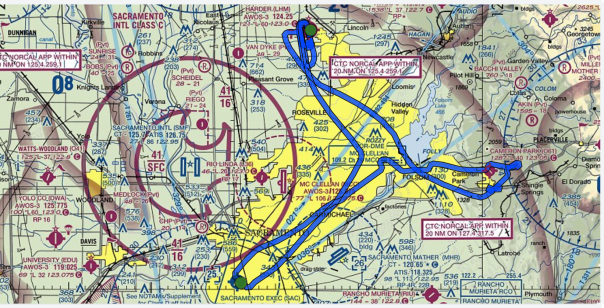
Checkride Route

High and Low Air Work

I’m flying with Steve today on dual instruction. As we climbed out of Livermore, I noticed deteriorating visibility which I assumed was a cloud layer. Steve pointed out that it was actually smoke from a very large wildfire burning near Big Sur on the California coast. On the east side of the Livermore ridge the conditions were a little better, enough for us to continue with a training flight after having had thoughts along the way of possibly turning back.

At 3000′ the smoke layer wasn’t bad so I did steep turns on the right and left. Still not very comfortable doing steep turns. Steve demonstrated a turn which was fairly steep  and he might have pulled up to keep the nose from dropping and I was not comfortable with the associated sensations.

Next we did slow flight and then a few different stalls – power off stall in the landing configuration, power-off stall on a right turn and then a power-on stall.

We went through a routine engine out simulation and at the end of it we spotted the pipeline and transitioned into S-turns. At that time I spotted another aircraft which was also flying at our low altitude seemingly also using the pipeline for making S-turns. We watched it for a while as it appeared they were leaving the area but then they really didn’t. After one turn we decided to leave the area and do turns about a point at a nearby location.

Lots of traffic everywhere today. As we were approaching Byron and announced our position over Discovery Bay, another aircraft was taking off and was going to do a 270 en route to Livermore. That would put it coming straight at us at comparable altitude. Radio communications helped save the day with each other knowing our locations.

There were gliders flying today at Byron and there was unexpected thermals as we approached the threshold for Rwy 30 that caused me to stay up longer even though I had pulled out the power on the engine. Two touch and go and we headed back to Livermore.

New Year Flight

Today the winds were calm and clouds were 4900′ scattered. As we taxied out, we noticed that the construction of Three Rivers FBO is making good progress and they are getting ready to open by Super Bowl. The new fuel station has been opened and the old one removed. Miraculously, the intercom in the back seat of N906MD has been fixed! We no longer need an intercom extender and people in the front seats can hear the person in the back.

We headed to Byron and made steep turns in the vicinity of the airport. Upon rolling out of the steep turn, use opposite rudder to stop the turn. Then Srinath practiced slow flight followed by three kinds of stall. First, power-on (departure) stall. Upon reaching stall, just relax the back pressure on the yoke. Because it is a power-on stall, the engine is already running pretty hard so relaxing the yoke should cause it to recover quickly. If you shove the power in, more altitude will be lost before recovery. It is only in a power-off stall that once recovery is achieved with relaxing the yoke that the power should be shoved in.

Power-off stall was next, followed by an approach to landing stall. Start with a pre-landing checklist, then come back on the power to extend full flaps while within the white arc. Achieve a descent as if we are coming in for landing. Then pull back to stall. Recovery is the same as a power-off stall – relax the yoke to drop the nose and build up airspeed then shove full throttle. So we went through all varieties of stalls today.

Steve pulled back the throttle to simulate an engine out situation. The ABC checklist comes in handy here – Airspeed, Best place to land, Checklist to attempt restarting the engine. It is important to achieve and maintain the airspeed for best glide. On the 172 that is 65kts. Then you determine the direction of wind and scout for the best place to land. Preferably you land into the wind. In our case we found a restricted runway which of course would have been fair game in the event of an emergency. Keep the runway in view all the time as you weave around and descend. If there was no runway, look for a hard field or green field but certainly not one that is wet or just recently plowed. Land along the furrows if there are any.

We proceeded to a long pipe in the vicinity, descended to 800′ AGL and made S-turns by entering downwind. The first maneuver was intended to watch for the wind and the right turn ended up being too shallow because the wind pushed us into the turn. On the next attempt Srinath proceed a little further ahead before attempting the turn. He could also have tried a shallower right turn so the wind pushing us back would have made it a fine semicircular turn.

Finally Steve asked Srinath to use the GPS to take us directly to Byron. He landed by making a right base turn and after touchdown Srinath tried maneuvering the plane to get on the centerline which Steve reminded him never to do so for the risk of getting into a ground loop. Just staying parallel to the runway is sufficient. Srinath took off with a soft-field technique. Once the nose comes up off the “dirt”, shove in full power to maintain the nose slightly off the runway until the plane lifts off. Then push the yoke forward to stay in ground effect to build up airspeed before climbing out.

Finally, maximum performance takeoff. Stand on the brakes and shove the throttle fully in. Watch the RPM come up to 2200 and then release the brakes. Plane will race forward rapidly. Maintain control and at 60kts, pull back on the yoke to climb at Vx until a “50-foot obstacle” has been cleared. Then relax the back pressure to build up airspeed and climb at Vy. After a pattern, Srinath did a precision landing on the numbers. One more maximum performance takeoff followed by a 270 turn to overfly midfield before heading back to Livermore.

A bit of drama on the way back to Livermore. Our radio didn’t connect well and we barely heard the tower transmission after we reported our position over Brushy Peak. Tower asked another aircraft in the vicinity to check if we could hear them. In the meantime, because of this, Steve took us on a 360 right  turn to maintain position over Brushy Peak while we re-established connection. A mooney was taking off from Livermore and heading in our general direction, which is probably why Steve did the turn. We were soon cleared in to land on runway 7L.

Butterfly with sunburned feet

As we headed out of Livermore towards the hills, Steve pulled the power simulating an engine out. Srinath immediately banked left to get away from the rising terrain but he was a little slow to achieve glide path. Once he spotted a private runway which could be used for an emergency landing, he brought back the power and we turned 180 to head towards Tracy again.

Above Tracy, it was time for steep turns one in each direction. Next was slow flight followed by power off stall and approach to landing stall. Soon we were close to New Jerusalem and Steve spotted crop circles over which Srinath executed ground reference maneuvers – turns around a point – again once in each direction. At the end of this maneuver, we were less than 2mi from New J so we headed there for touch and go.

Srinath got practice with a straight-in landing and many soft field takeoffs and landings. It takes practice and experimentation to stay in ground effect upon takeoff to build up airspeed prior to climb out. It also takes practice to keep the nose just high enough at takeoff, without the tail striking the runway. Soft field landing is like a butterfly with sunburned feet trying to touch down.

On the way back to Livermore, Steve reminisced about N25ES and how much he misses it. He recounted how the club acquired the plane and how 857, the previous 172, was sold. Steve landed us at Livermore demonstrating a short field landing technique.

Bellanca Aries Sighted

As we flew over the Tracy airport, we noticed that it has now been re-opened after the runways were resurfaced and painted. Srinath started off by performing steep turns near Tracy. Next was slow flight, stall in the clean configuration and an approach to landing stall. Here is a sequence of steps for an approach to landing stall – first establish a steady descent, lower RPM to the airport pattern rate, full flaps and then trigger the stall. For recovery, drop the nose to break the stall, turn off carburetor heat, full power and minimize altitude loss.

Steve pulled off power simulating an engine out situation. Then a few landings at New Jerusalem followed by ground reference maneuver – turns around a crop circle, then turns around a point.

Upon landing at Livermore, we saw a very rare aircraft taxiing past us. It was a Bellanca Aries (N250DJ) – only one of 2 still flying out of the 4 aircraft ever made. This one was owned by Jim Rhoades of Livermore. See more details on this blog.

Air work and strong winds

After reviewing audio from the previous flight’s recording, we determined that the intercom was not working on the rear inputs. We can only hear the radio come through so unfortunately none of the cockpit chatter was recorded. While I squawked about this issue, since the plane is owned by Five Rivers Aviation it is really up to them to fix it.

Departed Livermore in the evening into a headwind. We flew our regular course towards Byron but the ASOS reported winds were too strong from 220 at 15 gusting to 21. Steve decided we should head towards New Jerusalem instead so we banked right over Fore Bay and did two sets of steep turns to the left then to the right. Followed by slow flight with shallow turns, power-off stall, a stall on right turn and a power-on stall. Then we did an engine out simulation.

By now the Byron area winds have increased to 20kts@220. We shot a straight in landing on Rwy 23. It was really bumpy over Fore Bay and more so as we approached the runway. We ended up being too high so the first approach and a landing wasn’t salvageable. We did a go-around and gave it one more try (good landing this time) before heading back to Livermore.

Flaps + Power = Flower

A couple of days ago on June 30 we did a bunch of landings at Livermore. All them were decent or better, with one of them very good that Steve didn’t feel compelled to give me any instructions.

We started today with steep turns, power-off stall and then a simulated engine-out landing at Byron. On this approach we had quite a bit of altitude to lose. We tried a slip but that didn’t bring us down much because of headwinds. Then we tried S-turns to lose altitude. After 4 landings, we decided to head to New Jerusalem. It was a warm and cloudy day. The density altitude at Tracy was reported as 1600′. Reflecting on the landings at Byron I suggested that maybe extending downwind would have made it easier to land. Steve was emphatic (7:34 into the video) that that was not only necessary but it will provide more opportunities to botch a landing.

On the first landing at New Jerusalem, I came down hard and bounced up quite a bit. I didn’t react quickly so Steve shoved in the throttle (8:24) and did a go around. Rightfully he gave me an earful. The second landing was ok – flared up a little too much but was able to bring the plane down just fine. After two more good landings, Steve endorsed me to fly solo.

It was unnerving to hear Steve ask me to fly solo but once I got into the cockpit and started the preparations, all such nervousness dissipated. During the flight there was so much to mentally manage that there was no time to feel nervous. I felt ready to handle it with all the training I’d received. The first landing was alright but on the second landing I bounced. And bounced high. Thankfully Steve’s words must have stuck in the back of my mind because I immediately pushed the throttle forward and did a go-around. The nose wanted to point way high up with full flaps deployed for the landing and I remember pushing forward hard on the yoke to fly nearly level and build up airspeed before climbing and slowly retracting the flaps a notch at a time. Perhaps I came in too fast and too flat causing the serious bounce. Since I did a go-around, I decided to do two more landings for a total of 4. They were not great but I managed to make them stick. The rest of the flight back home was uneventful.

This unfortunately ended up being my last flight on N25ES. In the following week another member of my flying club flew the plane and while practicing touch-and-go at Livermore bounced hard on a landing. The plane porpoised but the pilot did not attempt a go-around expecting to salvage the landing. The nose gear touched down first and the prop stuck the tarmac. The pilot was fortunately alright. He was a low-time pilot (having recently earned his private pilot’s license on the Cessna 152 and only a couple of hours of experience on the 172) and didn’t realize the seriousness of what had just happened. He did a few more touch-and-go before calling it quits. Later inspection revealed that the tip of one prop had broken off and the firewall had buckled. The plane ended up as a total loss and an insurance claim. The club has started a search for a replacement 172.

PS: In case you are wondering about the title of this blog, check out (9:37) into the pre-solo video.

Foray into night flying

Srinath’s turn to fly today. I headed straight from work to the airport. Unfortunately we forgot to pack the GoPro so today’s video was shot on a handheld iPhone and we don’t have an audio feed.

We started with high air work – steep turns, slow flight, stall and recovery. Then we headed to Byron for some landings. By now it was inching closer to dusk and since this was a training flight with our instructor, we were not constrained by the night flying rules.

Speaking of night, there are three different definitions in the FAR for different purposes. FAR 1.1 defines night as the time from the end of evening civil twilight to the beginning of morning civil twilight as published in the air almanac, converted to local time. This is for logging night flying hours. FAR 61.57(b) defines night takeoff and landing experience required for PIC. Night in this context is defined as starting one hour after sunset and ending one hour before sunrise. Three takeoffs and landings to a full stop are required within the preceding 90 days to be current. Finally FAR 91.209 talks about turning on position lights from sunset to sunrise.

Here is how I remember the three regulations. First of all, civil twilight is when the sun is at or up to 6 degrees below the horizon. At most latitudes (except as you approach the poles), civil twilight lasts less than an hour. So there are three regulations and they apply to three points in time – sunset, twilight and one-hour-after-sunset. Just as we would in a car, we should turn on the lights as early as possible. Sunset is the earliest of the three times and it makes sense to turn on position lights at this time. As a pilot in command carrying passengers, you want to be proficient in night landings. It makes sense for the regulations to stipulate currency requirements in the worst case scenario (i.e.) when it is the darkest. This is one-hour-after-sunset among the three times. That leaves night logging for hours starting with the end of evening civil twilight and ending at the start of morning twilight (i.e.) when the sun is at least 6 degrees below the horizon.

After a few landings, Srinath flew back to Livermore for a night landing.

More high air work

We were heading towards New Jerusalem and had entered the hills east of Livermore. Steve suddenly pulled the power (engine out simulation) and asked Srinath what he would do. Srinath suggested checking the fuel gauges (wrong), restarting the engine (wrong). Then he was scouting for a location (wrong). We were losing altitude and the terrain beneath us was climbing so the first thing to do was to turn 180 and head out of the hills back to the valley from which we approached. Steve took over the plane, made a steep turn to the left 180 degrees and got us pointing out of the hills towards the Livermore valley. This way we have increasing altitude under us. Then we scout for a place to make an emergency landing. We had a couple of back roads and some green fields and that was it. The exercise was over, we put the throttle back in, turned 180 and headed back into the hills, aimed for the valleys since we were still climbing slowly and again wanted more altitude underneath us.

Later, we headed towards New Jerusalem for steep turns, slow flight. When making turns in slow flight, look at the turn and bank indicator to make sure the turn isn’t steep. Don’t go beyond the first notch. Next, stall in the landing configuration – Steve demonstrated why you don’t dump all the flaps at once. We lost lift and descended at about 2000′ a minute even though the engine was powered up. Of course, this can be serious when you are close to the ground and starting a go-around.

Finally, some landings at New Jerusalem and then back to Livermore.

More steep turns, Ground reference maneuvers

It was a fairly warm day and right from the initial climb the engine ran hot. There was a crosswind at takeoff, managed with right rudder and right aileron.

First off some more steep turns. Srinath is still inadvertently making them too steep and needs more practice. You can see me at 4:06 in the video holding on to dear life as Srinath pulled up steeply to correct a nose down pitch attitude during the turn.

Engine heat was getting very close to the red line. So it was time for an engine out simulation to cool it down. After setting glide speed and scouting for a place to land, at about 300′ we decided to climb back up with throttle simulating a go-around.

Next, at 800′ altitude Srinath started S-turn ground reference maneuvers. In the area north of Byron, we found a long pipeline running east-west for reference. Always enter the turn on downwind, Steve instructed. The first turn is to get a feel for the wind speed and direction to judge where to turn and how much.

The next maneuver was 8-turns around a pylon at around 800′ altitude. The two anchor points were a white tank and a pickup truck. Midway through the maneuver, the truck started moving so we had to choose an outhouse as a different pylon. We noticed another plane making 8-turns at an altitude below us. At one point we came pretty close and the instructor took over to avoid. We turned back to Livermore and on the way back before we climbed the hills another plane was at the 9 o’clock direction. He was coming in the opposite direction, passed us on the left and turned left behind us.