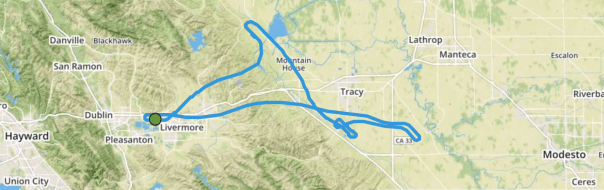
Today I set out to practice solo stalls for the first time. I had 737GM reserved and it was mostly a smooth ride as I flew over Byron airport at 2500′ heading to the practice area. At 3000′ I started practicing slow flight and making shallow turns at slow flight. But first, by making clearing turns.
After slow flight, in the landing configuration I tried a stall first and then dropped the nose before the stall was achieved. Tried it again and this time the stall was achieved with quick recovery. Very quickly I decided that was enough and proceed for a couple of touch and go’s at Tracy airport before heading back to Livermore. By the time I returned, winds had shifted and I landed on 7L as tower switched the traffic around to make up for a northeasterly wind.
Starting up 737GM was a bit of a bear but chose to fly it this morning because 906MD’s carburetor was being re-worked due to starting problems. Tower cleared me for takeoff on 7L. Winds 130@5kts but quite variable.
Flight to Byron was quite straightforward and it was a good smooth landing. On the flight from Byron to Tracy, I had still been tuned to the Byron radio and I was wondering why Tracy traffic wasn’t announcing on the radio. I was still hearing Byron traffic. While in the pattern at Tracy, I saw an aircraft taking off and one waiting to take off and I had not heard either of them speak on the radio. It was only when I was nearing base turn in the Tracy pattern that I realized my mistake. Landing at Tracy was also good. I next proceeded to New Jerusalem where it was a bouncy touch and go. The flight back to Livermore was uneventful.
Today was my first solo flight taking off and flying outside of Livermore. I went to Byron, then Tracy and back.
As I requested frequency change approaching brushy peak, tower alerted me to traffic in the opposite direction which I never was able to locate. After touching down at Byron, I taxied off to reset for the leg to Tracy. On the way back to Livermore as I approached Altamont, tower first alerted me to a traffic 1mi south for straight in to 25R and asked me to report for a 2mi right base implying I had to turn right towards brushy peak. Then tower changed the instructions to make a right 360 and then straight in for 25R.
Srinath was on the left seat today and he started with a soft field takeoff and left downwind departure. At Tracy, winds were from 310@7kts where he did a soft field landing. The sink hole just past the threshold of rwy 30 is to be respected. There is usually an appreciable downdraft as the plane passes over the sink hole so anticipate it and increase the power a little bit. As you clear the sink hole and approach the threshold, ease back on the power and the word I keep hearing Steve repeat is “patience…patience” to wait for the runway to approach the aircraft. In other words, descend slowly for a gentle touchdown.
Next we headed for New Jerusalem by making a left 270 over the runway and passing over mid-field. The runways at both Tracy and New J were slick and wet from rains and that calls for extra caution while using brakes. We landed twice at New J, the second landing took up quite a bit of runway so we turned around. And since the winds were low (estimated 8-10kts), Steve asked Srinath to take off on rwy 12 so he can see how the tailwind leads to a significantly longer ground roll before takeoff.
Next, we headed to Byron against stiff headwinds from 310@15kts. We heard a Piper (58K from our club) on the radio practicing patterns and a glider coming in to land at the airport as well. This was a great practice session anticipating where the traffic would be as we executed a straight-in approached for rwy 30. Steve had a little fun on the radio with Mike (CFI on 58K) when he recognized the voice. Srinath and I both had questions for Steve as we were trying to figure out the spatial locations where the three aircrafts would be as we approached further. Since 58K was on final and we were coming up on 5 miles, we anticipated that we’ll land before 58K comes around for its next pattern. What we didn’t factor into the equation was the fact that we were going against a stiff headwind in a low power setting for landing and 58K would be gunning its engines for takeoff, followed by a stiff tailwind towards us on the downwind leg. Our ground speed was only 40kts and then 35kts as we got lower and closer.
Mike couldn’t spot us so we announced that we were a quarter mile shy of the second canal. What Steve meant was the second canal seen from our approach the runway i.e. the closer one to the airport. Mike understood that we were on the second canal from the airport i.e. the farther one from the airport. So he announced that he was turning base in front of us. We were all taken by surprise when he announced that and saw 58K turn directly towards us. Steve immediately took evasive action by banking left and as soon as we turned, Mike was able to see us and apologized for the mixup. We let Mike land and in the meantime we did a left 360 and lined up to land on rwy 30.
Srinath capped off the training with a few touch-and-go’s at Livermore performing short approach landings.
Today wind was 240@9kts at Livermore.We departed right downwind towards Byron where the wind was 210@6kts and clear skies.Apparently I was still on Livermore tower frequency (00:21:12 in the video) when I announced on the radio that we were inbound for Rwy 23. We did a short field landing (02:09:00) at Byron followed by a maximum performance takeoff (02:35:00). Next we proceeded to Tracy (winds 260@10) and did a soft field landing on Rwy 26 (05:32:22) followed by a regular takeoff.
We next headed to New Jerusalem which is only 7 miles away and aimed for Rwy 30. Winds were from 260 (no ATIS or AWOS in New J so we go by the Tracy weather) so it was a crosswind (06:39:00) for Rwy 30. We only employed 20 degrees of flaps and that caused us not to sufficiently slow down and remain low for landing. As we approached the runway, the airspeed got very low to 50kts and Steve pushed the throttle for a go-around at the last minute (07:32:19) as the stall horn started going off. I was apparently not watching the airspeed at all, being more intent on getting the plane low enough (through a slip) for the landing (10:02:04). That was a close call. On reflection, the thought did cross my mind that perhaps I should go around given I was so high. I should have gone around as soon as the thought crossed my mind. We did two more successful attempts before heading back to Livermore.
Over the Altamont pass just before I was going to call Livermore tower, I saw an aircraft coming straight at us. I simply pointed it out to Steve (11:32:24) who immediately banked us sharply to the left and we noticed the other aircraft pass us (slightly below). It seemed like it would have been a head-on approach and that got me quite shaken up. I should have gotten us out of trouble the moment I saw the aircraft. In reviewing the radio communications just prior, there were two aircrafts that had departed Livermore. 53MM was ahead of 7E(something) and 7E(something) confirmed to the tower that the Cherokee traffic ahead of it was in sight (11:02:11). Tower then approved 7E(something) for a frequency chance and then radio’ed 53MM that traffic was behind to its left at 2500′ and had 53MM in sight. 53MM’s frequency change was next approved. So both those aircraft were heading towards us and no longer talking to Livermore Tower. We were tuned into the Livermore Tower frequency but the three of us were neither talking to each other, nor talking to the Tower. We were in a see and avoid territory and while I saw what was most likely 53MM, I was slow to avoid. Maybe I had a premonition about this event because I asked Steve a question at the start of our flight (00:02:18 in the video) about how we deal with oncoming traffic that uses the same general path.
Back at Livermore, Steve sent me off to fly my solo in a pattern around a towered airport. I did 3 touch and go’s and on all three attempts I was #2 behind another aircraft. I had to extend my downwind leg, watch for the aircraft ahead of me before turning base.
Perfect weather today with calm winds. We headed to Byron first. An airport vehicle was performing runway field inspection at Byron on the 23/05 runway, but only after radioing to confirm nobody will be headed that way. We announced our intention to land on 30.
We did a regular landing and takeoff at Byron followed by a soft field landing and takeoff at Tracy and a no flap landing at New J. On the last one, I significantly overshot the runway (because we were faster than usual) before correcting for the landing. On the next landing, used a slip to slow down and drop altitude. Balked landing next – “there is a cow on the runway”. Final landing was a bit rough, after which Steve asked me to fly a solo completing three patterns around the airport.
There was a pickup truck beside the runway at New J which we had spotted on the first approach. It was apparently owned by a CFI who happened to be there that day to fly a paraglider (which was tucked into his trunk). After the solo, Steve told me that that CFI complimented me on all three landings and takeoffs.
We didn’t know Steve was going to ask Srinath to do his second solo today. The training started off with Srinath flying through Byron, Tracy and New Jerusalem practicing soft field takeoffs and landings. The solo was then at New Jerusalem where he did 3 takeoffs and landings. I gave Srinath some relief by flying 6MD back to Livermore.
A couple of days ago on June 30 we did a bunch of landings at Livermore. All them were decent or better, with one of them very good that Steve didn’t feel compelled to give me any instructions.
We started today with steep turns, power-off stall and then a simulated engine-out landing at Byron. On this approach we had quite a bit of altitude to lose. We tried a slip but that didn’t bring us down much because of headwinds. Then we tried S-turns to lose altitude. After 4 landings, we decided to head to New Jerusalem. It was a warm and cloudy day. The density altitude at Tracy was reported as 1600′. Reflecting on the landings at Byron I suggested that maybe extending downwind would have made it easier to land. Steve was emphatic (7:34 into the video) that that was not only necessary but it will provide more opportunities to botch a landing.
On the first landing at New Jerusalem, I came down hard and bounced up quite a bit. I didn’t react quickly so Steve shoved in the throttle (8:24) and did a go around. Rightfully he gave me an earful. The second landing was ok – flared up a little too much but was able to bring the plane down just fine. After two more good landings, Steve endorsed me to fly solo.
It was unnerving to hear Steve ask me to fly solo but once I got into the cockpit and started the preparations, all such nervousness dissipated. During the flight there was so much to mentally manage that there was no time to feel nervous. I felt ready to handle it with all the training I’d received. The first landing was alright but on the second landing I bounced. And bounced high. Thankfully Steve’s words must have stuck in the back of my mind because I immediately pushed the throttle forward and did a go-around. The nose wanted to point way high up with full flaps deployed for the landing and I remember pushing forward hard on the yoke to fly nearly level and build up airspeed before climbing and slowly retracting the flaps a notch at a time. Perhaps I came in too fast and too flat causing the serious bounce. Since I did a go-around, I decided to do two more landings for a total of 4. They were not great but I managed to make them stick. The rest of the flight back home was uneventful.
This unfortunately ended up being my last flight on N25ES. In the following week another member of my flying club flew the plane and while practicing touch-and-go at Livermore bounced hard on a landing. The plane porpoised but the pilot did not attempt a go-around expecting to salvage the landing. The nose gear touched down first and the prop stuck the tarmac. The pilot was fortunately alright. He was a low-time pilot (having recently earned his private pilot’s license on the Cessna 152 and only a couple of hours of experience on the 172) and didn’t realize the seriousness of what had just happened. He did a few more touch-and-go before calling it quits. Later inspection revealed that the tip of one prop had broken off and the firewall had buckled. The plane ended up as a total loss and an insurance claim. The club has started a search for a replacement 172.
PS: In case you are wondering about the title of this blog, check out (9:37) into the pre-solo video.
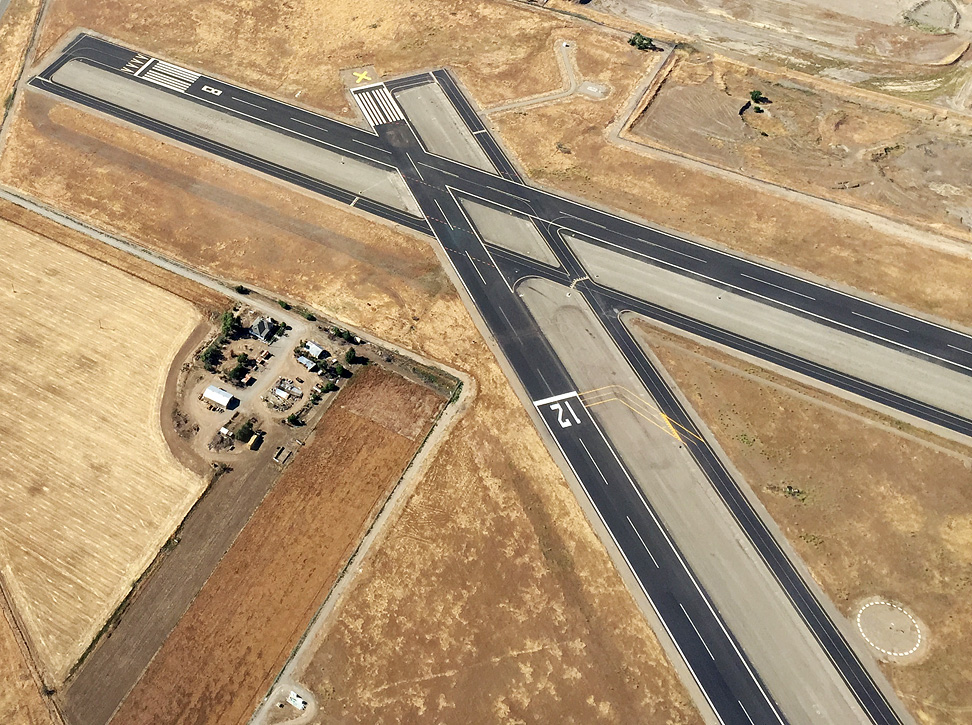
Steve gave us a heads-up that we will fly over the Tracy airport so we can see some changes for ourselves. The runways were getting a makeover aka resurfacing. The threshold for Rwy 12 has been relocated so that Rwy 8/26 can be reconstructed. So the usable portion of 12/30 is now significantly shorter. Taxiways had been redrawn.
Next, Srinath had a chance to practice slow flight and shallow turns and a power-off stall. He lost just a couple of hundred feet during recovery. Next was ground reference maneuver – turns around a point. Today the sight picture beneath us was a rectangular area as opposed to a crop circle as we’ve seen before. Finally, a few cross-wind landings at New Jerusalem before heading back to Livermore.


 Crab Tales