Tag Archives: turns around a point

High and Low Air Work

I’m flying with Steve today on dual instruction. As we climbed out of Livermore, I noticed deteriorating visibility which I assumed was a cloud layer. Steve pointed out that it was actually smoke from a very large wildfire burning near Big Sur on the California coast. On the east side of the Livermore ridge the conditions were a little better, enough for us to continue with a training flight after having had thoughts along the way of possibly turning back.

At 3000′ the smoke layer wasn’t bad so I did steep turns on the right and left. Still not very comfortable doing steep turns. Steve demonstrated a turn which was fairly steep  and he might have pulled up to keep the nose from dropping and I was not comfortable with the associated sensations.

Next we did slow flight and then a few different stalls – power off stall in the landing configuration, power-off stall on a right turn and then a power-on stall.

We went through a routine engine out simulation and at the end of it we spotted the pipeline and transitioned into S-turns. At that time I spotted another aircraft which was also flying at our low altitude seemingly also using the pipeline for making S-turns. We watched it for a while as it appeared they were leaving the area but then they really didn’t. After one turn we decided to leave the area and do turns about a point at a nearby location.

Lots of traffic everywhere today. As we were approaching Byron and announced our position over Discovery Bay, another aircraft was taking off and was going to do a 270 en route to Livermore. That would put it coming straight at us at comparable altitude. Radio communications helped save the day with each other knowing our locations.

There were gliders flying today at Byron and there was unexpected thermals as we approached the threshold for Rwy 30 that caused me to stay up longer even though I had pulled out the power on the engine. Two touch and go and we headed back to Livermore.
Butterfly with sunburned feet

As we headed out of Livermore towards the hills, Steve pulled the power simulating an engine out. Srinath immediately banked left to get away from the rising terrain but he was a little slow to achieve glide path. Once he spotted a private runway which could be used for an emergency landing, he brought back the power and we turned 180 to head towards Tracy again.

Above Tracy, it was time for steep turns one in each direction. Next was slow flight followed by power off stall and approach to landing stall. Soon we were close to New Jerusalem and Steve spotted crop circles over which Srinath executed ground reference maneuvers – turns around a point – again once in each direction. At the end of this maneuver, we were less than 2mi from New J so we headed there for touch and go.

Srinath got practice with a straight-in landing and many soft field takeoffs and landings. It takes practice and experimentation to stay in ground effect upon takeoff to build up airspeed prior to climb out. It also takes practice to keep the nose just high enough at takeoff, without the tail striking the runway. Soft field landing is like a butterfly with sunburned feet trying to touch down.

On the way back to Livermore, Steve reminisced about N25ES and how much he misses it. He recounted how the club acquired the plane and how 857, the previous 172, was sold. Steve landed us at Livermore demonstrating a short field landing technique.

Bellanca Aries Sighted

As we flew over the Tracy airport, we noticed that it has now been re-opened after the runways were resurfaced and painted. Srinath started off by performing steep turns near Tracy. Next was slow flight, stall in the clean configuration and an approach to landing stall. Here is a sequence of steps for an approach to landing stall – first establish a steady descent, lower RPM to the airport pattern rate, full flaps and then trigger the stall. For recovery, drop the nose to break the stall, turn off carburetor heat, full power and minimize altitude loss.

Steve pulled off power simulating an engine out situation. Then a few landings at New Jerusalem followed by ground reference maneuver – turns around a crop circle, then turns around a point.

Upon landing at Livermore, we saw a very rare aircraft taxiing past us. It was a Bellanca Aries (N250DJ) – only one of 2 still flying out of the 4 aircraft ever made. This one was owned by Jim Rhoades of Livermore. See more details on this blog.

Falling Leaf Stall, Ground Reference Maneuvers, Touch and Go

Winds 230@12, foggy morning but we saw some holes in the south east sky. So we are going to poke through it because east of the hills is supposed to be clear weather. The climb was quite turbulent as we stayed low below the clouds, but high enough to clear the hills. This was the first time we’ve flown through scattered clouds. Along the way, an aerial view of Lake Del Valle with its dark green waters was quite rewarding. We kept poking through holes in the clouds and following valleys beneath to maintain the maximum possible ground clearance. Once we crossed Lake Del Valle, it was time to bank left and head for the central valley.

Srinath started with the falling leaf stall – his first time consciously doing the maneuver. As expected, the plane buffeted and was unhappy (to quote Steve) because Srinath kept the elevators aft and used the rudders to maintain wings level without letting the nose drop. Then time for a few touch and go’s at New Jerusalem. However we were too high at 2000′ and Srinath used a side slip to lose some altitude quickly.

Next, turns about a point. First around a crop circle counterclockwise and then clockwise. Next, we moved west to find a point on the ground (a house) and then turns to the left and then the right. Along the way, we heard on the radio that skydivers were jumping off  an airplane at 13,000′ over Lodi airport.

KTCY is getting a makeover

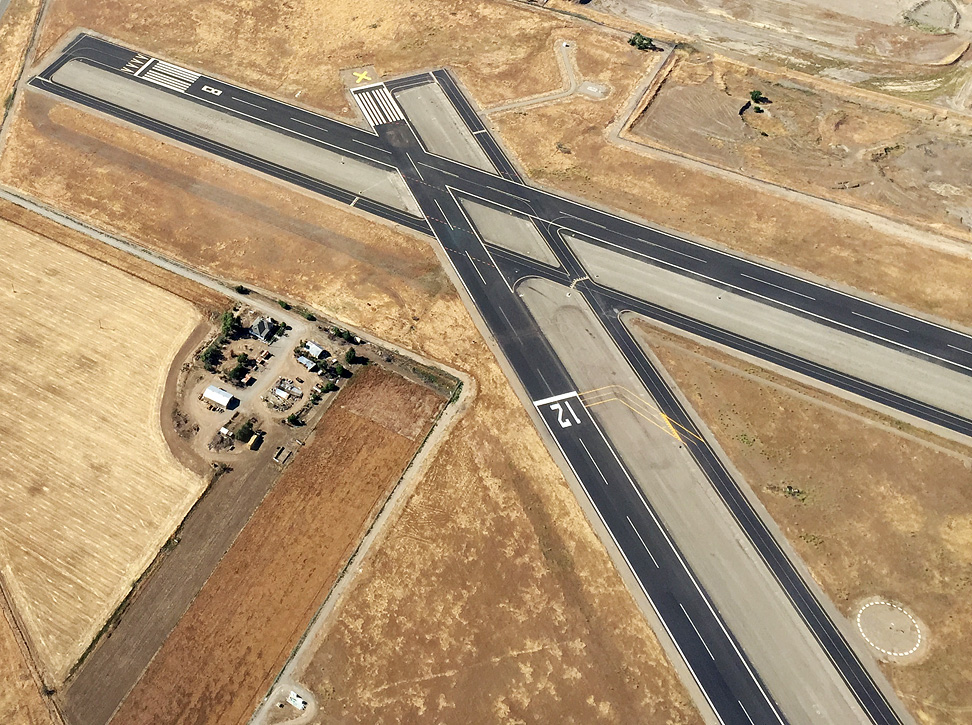
Steve gave us a heads-up that we will fly over the Tracy airport so we can see some changes for ourselves. The runways were getting a makeover aka resurfacing. The threshold for Rwy 12 has been relocated so that Rwy 8/26 can be reconstructed. So the usable portion of 12/30 is now significantly shorter. Taxiways had been redrawn.

Tracy Runway Makeover

Next, Srinath had a chance to practice slow flight and shallow turns and a power-off stall. He lost just a couple of hundred feet during recovery. Next was ground reference maneuver – turns around a point. Today the sight picture beneath us was a rectangular area as opposed to a crop circle as we’ve seen before. Finally, a few cross-wind landings at New Jerusalem before heading back to Livermore.

Apr19TrackLog

Training after quite a break

Starting off with slow flight and shallow turns, then a stall in landing configuration. But first, clearing turns first on the right, then the left. We heard the ATC tell another pilot in the area that we were about a mile west of New Jerusalem and that we were doing some maneuvers and 360 turns.

Then an engine out simulation. We went through the checklist before finding a place to land.

Turns around a point, both right and left, a couple of miles from New Jerusalem. There were two adjacent fields with crop circles which made it somewhat manageable visually although right turns were harder than left due to lack of sight picture. [This part was edited out of the video]

We were going to practice touch and go at New Jerusalem but then we had a unique experience. As we approached the airport we spotted stuff on the runway. We planned a fly over to identify what it was. The runway had an X on it meaning it was closed and there were containers on the runway. Steve guessed it was probably Myth Busters doing something at the runway.

So we headed for Tracy instead. First taste of cross wind landing at tracy. Winds from 240 @ 9kts and we aimed to land on Rwy 30. Left wing down for takeoff and right rudder. The airport has a tetrahedron to indicate wind direction. After a few landings, we headed back to Livermore.

Happy new year!

This morning the winds were from 050 at 9kts. So runway 7L and 7R were in operation. This meant a long taxi from our hangar and a good time to lean the mixture. Carburetors are calibrated to properly mix fuel with air at sea level. During normal engine operation, a proper air-fuel mixture is fully burned in the engine for optimal performance. When the engine runs at a low RPM (for instance while taxiing), the rich air-fuel mixture isn’t fully burned due to a cooler engine. This causes carbon buildup in the spark plugs and the fouling can result in lower engine performance. The carbon buildup can also occur if the mixture is too rich e.g. at higher altitudes where the air density is lower but unadjusted fuel density remains higher. For better engine performance, less likelihood of spark plugs fouling up and to warm the engine sooner, leaning the mixture is recommended when a long taxi is anticipated.

We start off by performing power-off stall recovery in the clean configuration. I was very slow in powering up the engine to recover from stalls and as a result dropped over 500′ on the first couple of attempts attempt. After many tries, ended up with between 50′-75′ of altitude loss.

Then Steve demonstrated a power-on stall with 2200 rpm on the engine i.e. not fully powered up. Power-on stalls typically occur during takeoff or a go-around. Listen for the stall horn and drop the nose. Steve demonstrated a tendency to spin to the left if the stall is not recognized quickly. If that happens, the first thing to do is to pull back the power and relax the back pressure to increase air speed over the wings to produce lift. Then power up and pull back.

Next was engine out simulation. First trim for a glide speed of 65kts. Then run through a checklist

  • Was the fuel selector accidentally kicked around or is the selector still on both?
  • Is the mixture rich?
  • Is the carburetor heat off?
  • Check the throttle
  • Check mag switch positions and whether that revives the engine
  • Check the primer if it is IN i.e. off.

Once the usual suspects have been eliminated, observe the wind and look for a place to land into the wind. Brown fields better than green (wet). Smooth fields better than plowed fields. If plowed, along the furrows better than across. No railroad tracks. Since we identified a place to land and it was pretty much beneath us, we had to lose altitude quickly. One could either perform 360 turns to lose altitude. Or, in this case Steve demonstrated a forward slip.

Time for a ground reference maneuver – turns around a point. It is important to enter the maneuver downwind and maintain about 800′ AGL. On the first orbit observe the effects of the wind and remember mental landmarks where the turns should occur. Subsequent turns are expected to be more accurate. At one point, Steve suddenly took over controls and performed an evasive action by banking the plane to the right. This was upon spotting another plane in the vicinity. Then back to the ground reference maneuver this time turns to the right.

Finally, time for some touch-and-go’s at Byron. Steve talking on the radio for each leg of the approach to Byron is quite informative. The first landing was pretty hard, second was good and the third was below average.

On the way back to Livermore, we had a close call with a Skycatcher coming towards us. Tower told us that the Skycatcher was 3 miles out at 2000′ and we were at 3100′. A couple of minutes later, the tower informed the Skycatcher (which was now at 2400′) that an inbound Cessna was 1.5 miles in front and suggested that he turn right. As I was commenting to Steve that 3100′ was about our altitude, he gestured me to turn right. While I was trying to process the information, the tower asked us to turn right because of the Skycatcher and Steve jumped on it right away to avoid the oncoming aircraft.