All posts by thenandakumars

Falling leaf stall

We started with an engine out simulation as we were climbing on downwind leg out of Livermore. Steve explained why we couldn’t go back to Livermore – because of headwinds if we turned towards the airport. After scouting a place to land, we quickly pushed the throttle back in and climbed on.

After we crossed the hills east of Livermore, Srinath tried three power off stalls. On the second one, the stall wasn’t fully reached before recovery and that is clear from the video where the nose didn’t quite drop.

Next, Steve showed us something new [2:55 into the video]. He forced a stall and instead of relaxing the back pressure as we usually do to break the stall, he kept it all the way back. So the plane continued to be stalled. One of the wings (left) dropped and without using the ailerons, used only the rudder to pick up that wing. [In the audio, Steve misspeaks about the right wing being down and using the right rudder to compensate]. Then he asked Srinath to hold the elevator all the way back and use only the rudder. He later mentioned that it was called the Falling Leaf Stall.

I needed to research this maneuver because we didn’t discuss it further that day with Steve. It turns out to be an uncommon high air work and found this article in the AOPA Flight Training magazine from 1998. In short, by keeping the wings level this maneuver makes the plane resemble a falling leaf. As the wings rock, it is picked up by using opposite rudder. In a stall, the ailerons have very little to no authority. The rudder is above the turbulent air flow washing off the wings and hence still has authority allowing the yaw to compensate for dropping wings.

We got to about 2000′ MSL and we ended the maneuver by breaking the stall and powering up the engine. Next was turns around a point and then figure 8 turns. Winds were from 220 at 21kts so that certainly made the ground references challenging.

We proceeded to Byron. Winds were from 220 at 22 gusting 29. It has been the most sustained turbulence we have experienced thus far in training. Srinath suggested we’d land on Rwy 30 which was the wrong choice. So Steve decided to give us an education by attempting the landing and then doing a go-around when the full rudder deflection wasn’t sufficient. The plane was visibly crabbed at an extreme angle and that was still insufficient for the launch. After the go-around, Srinath did two landings on Rwy 23 before heading back to Livermore for a landing well after sunset.
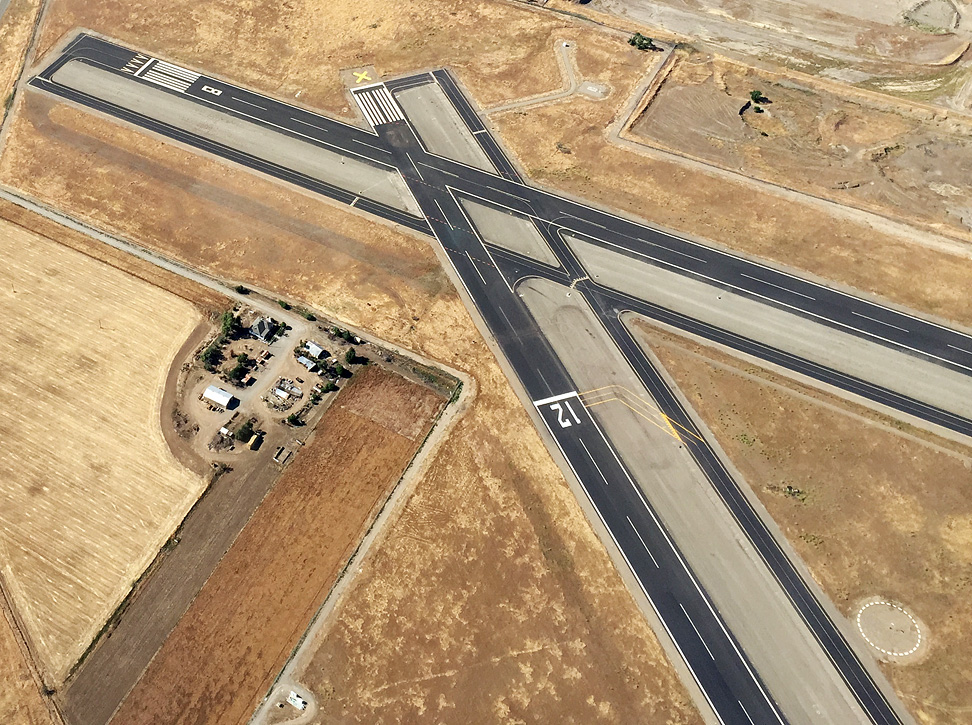
KTCY is getting a makeover

Steve gave us a heads-up that we will fly over the Tracy airport so we can see some changes for ourselves. The runways were getting a makeover aka resurfacing. The threshold for Rwy 12 has been relocated so that Rwy 8/26 can be reconstructed. So the usable portion of 12/30 is now significantly shorter. Taxiways had been redrawn.

Tracy Runway Makeover

Next, Srinath had a chance to practice slow flight and shallow turns and a power-off stall. He lost just a couple of hundred feet during recovery. Next was ground reference maneuver – turns around a point. Today the sight picture beneath us was a rectangular area as opposed to a crop circle as we’ve seen before. Finally, a few cross-wind landings at New Jerusalem before heading back to Livermore.

Apr19TrackLog

Training after quite a break

Starting off with slow flight and shallow turns, then a stall in landing configuration. But first, clearing turns first on the right, then the left. We heard the ATC tell another pilot in the area that we were about a mile west of New Jerusalem and that we were doing some maneuvers and 360 turns.

Then an engine out simulation. We went through the checklist before finding a place to land.

Turns around a point, both right and left, a couple of miles from New Jerusalem. There were two adjacent fields with crop circles which made it somewhat manageable visually although right turns were harder than left due to lack of sight picture. [This part was edited out of the video]

We were going to practice touch and go at New Jerusalem but then we had a unique experience. As we approached the airport we spotted stuff on the runway. We planned a fly over to identify what it was. The runway had an X on it meaning it was closed and there were containers on the runway. Steve guessed it was probably Myth Busters doing something at the runway.

So we headed for Tracy instead. First taste of cross wind landing at tracy. Winds from 240 @ 9kts and we aimed to land on Rwy 30. Left wing down for takeoff and right rudder. The airport has a tetrahedron to indicate wind direction. After a few landings, we headed back to Livermore.

Fog bank and Landings

This was to be Srinath’s cross-country flight. However as we cleared the Livermore ridge, central valley was covered with fog. We flew over it for a while and then returned to Tracy for touch-and-go. As Steve remarked, every plane is equipped with a 180-degree turn so we flew over the fog layer for about 8 minutes and then turned around. Along the way, Srinath got some experience dealing with VOR, looking for landmarks, guessing locations of airports in the vicinity based on heading and looking for holes in the fog layer if we needed to dip down. A few average landings at Tracy gave him more practice.

First Cross-Country Flight

Today we flew to Auburn (KAUN) northeast of Sacramento for my first cross-country flight. We requested flight following on both legs of the trip and it was particularly invaluable in alerting us to traffic in the area. We used VORs to navigate on the way to Auburn and supplemented that by spotting visual landmarks on the ground that we found on the sectional chart. On the way back, Mt.Diablo was our sentinel. As we got closer, Brushy Peak was the next guide.

Our plan was to have lunch at the airport restaurant at Auburn. However, it was fairly crowded and we didn’t think we’ll have a chance to be done and return the plane to Livermore by 1pm for the next pilot who had booked the 172. So we headed back to Livermore and lunched at Beeb’s instead.

First go-around

Slow flight and shallow turns to the right and left. Power off stall and recovery. Then simulating an engine out emergency. First, trim for a glide attitude for a speed of 65kts. Then attempt an engine restart by (1) checking that the fuel selector valve is on both, (2) mixture is rich, (3) carburetor heat is ON, (4) throttle is cracked open, (5) ignition switch is on BOTH, (6) primer is IN and locked in place. Start the engine if the propeller is stopped. If all of that fails…

Quickly scout for a place to land with wind direction in mind. In this case we were in the vicinity of New Jerusalem airport so we are going to try to land there. No wind today so we aim for Rwy 30. We were high so Srinath used a slip to get down quickly. In the case of an electrical failure the flaps won’t work so slips are a good technique to learn. After a couple of landings, Steve said there was a cow on the runway so Srinath did a go-around. A few more landings at New Jerusalem and then back to Livermore for a straight in landing.

Happy new year!

This morning the winds were from 050 at 9kts. So runway 7L and 7R were in operation. This meant a long taxi from our hangar and a good time to lean the mixture. Carburetors are calibrated to properly mix fuel with air at sea level. During normal engine operation, a proper air-fuel mixture is fully burned in the engine for optimal performance. When the engine runs at a low RPM (for instance while taxiing), the rich air-fuel mixture isn’t fully burned due to a cooler engine. This causes carbon buildup in the spark plugs and the fouling can result in lower engine performance. The carbon buildup can also occur if the mixture is too rich e.g. at higher altitudes where the air density is lower but unadjusted fuel density remains higher. For better engine performance, less likelihood of spark plugs fouling up and to warm the engine sooner, leaning the mixture is recommended when a long taxi is anticipated.

We start off by performing power-off stall recovery in the clean configuration. I was very slow in powering up the engine to recover from stalls and as a result dropped over 500′ on the first couple of attempts attempt. After many tries, ended up with between 50′-75′ of altitude loss.

Then Steve demonstrated a power-on stall with 2200 rpm on the engine i.e. not fully powered up. Power-on stalls typically occur during takeoff or a go-around. Listen for the stall horn and drop the nose. Steve demonstrated a tendency to spin to the left if the stall is not recognized quickly. If that happens, the first thing to do is to pull back the power and relax the back pressure to increase air speed over the wings to produce lift. Then power up and pull back.

Next was engine out simulation. First trim for a glide speed of 65kts. Then run through a checklist

  • Was the fuel selector accidentally kicked around or is the selector still on both?
  • Is the mixture rich?
  • Is the carburetor heat off?
  • Check the throttle
  • Check mag switch positions and whether that revives the engine
  • Check the primer if it is IN i.e. off.

Once the usual suspects have been eliminated, observe the wind and look for a place to land into the wind. Brown fields better than green (wet). Smooth fields better than plowed fields. If plowed, along the furrows better than across. No railroad tracks. Since we identified a place to land and it was pretty much beneath us, we had to lose altitude quickly. One could either perform 360 turns to lose altitude. Or, in this case Steve demonstrated a forward slip.

Time for a ground reference maneuver – turns around a point. It is important to enter the maneuver downwind and maintain about 800′ AGL. On the first orbit observe the effects of the wind and remember mental landmarks where the turns should occur. Subsequent turns are expected to be more accurate. At one point, Steve suddenly took over controls and performed an evasive action by banking the plane to the right. This was upon spotting another plane in the vicinity. Then back to the ground reference maneuver this time turns to the right.

Finally, time for some touch-and-go’s at Byron. Steve talking on the radio for each leg of the approach to Byron is quite informative. The first landing was pretty hard, second was good and the third was below average.

On the way back to Livermore, we had a close call with a Skycatcher coming towards us. Tower told us that the Skycatcher was 3 miles out at 2000′ and we were at 3100′. A couple of minutes later, the tower informed the Skycatcher (which was now at 2400′) that an inbound Cessna was 1.5 miles in front and suggested that he turn right. As I was commenting to Steve that 3100′ was about our altitude, he gestured me to turn right. While I was trying to process the information, the tower asked us to turn right because of the Skycatcher and Steve jumped on it right away to avoid the oncoming aircraft.

Foray into night flying

Srinath’s turn to fly today. I headed straight from work to the airport. Unfortunately we forgot to pack the GoPro so today’s video was shot on a handheld iPhone and we don’t have an audio feed.

We started with high air work – steep turns, slow flight, stall and recovery. Then we headed to Byron for some landings. By now it was inching closer to dusk and since this was a training flight with our instructor, we were not constrained by the night flying rules.

Speaking of night, there are three different definitions in the FAR for different purposes. FAR 1.1 defines night as the time from the end of evening civil twilight to the beginning of morning civil twilight as published in the air almanac, converted to local time. This is for logging night flying hours. FAR 61.57(b) defines night takeoff and landing experience required for PIC. Night in this context is defined as starting one hour after sunset and ending one hour before sunrise. Three takeoffs and landings to a full stop are required within the preceding 90 days to be current. Finally FAR 91.209 talks about turning on position lights from sunset to sunrise.

Here is how I remember the three regulations. First of all, civil twilight is when the sun is at or up to 6 degrees below the horizon. At most latitudes (except as you approach the poles), civil twilight lasts less than an hour. So there are three regulations and they apply to three points in time – sunset, twilight and one-hour-after-sunset. Just as we would in a car, we should turn on the lights as early as possible. Sunset is the earliest of the three times and it makes sense to turn on position lights at this time. As a pilot in command carrying passengers, you want to be proficient in night landings. It makes sense for the regulations to stipulate currency requirements in the worst case scenario (i.e.) when it is the darkest. This is one-hour-after-sunset among the three times. That leaves night logging for hours starting with the end of evening civil twilight and ending at the start of morning twilight (i.e.) when the sun is at least 6 degrees below the horizon.

After a few landings, Srinath flew back to Livermore for a night landing.