Tag Archives: KSAC

PPL-ASEL Checkride

Last week I called my DPE as previously discussed and got a cross country from KLHM to KMRY for planning. Also, I got the weight and balance details which I worked out in advance. Otherwise, I was asked to prepare per the ACS.

I arrived at Lincoln last evening and stayed overnight. Lincoln airport charges a $5 transient parking fee for overnight tie down. You can pay at the self-service box on the ramp. You can get an Uber from the airport to one of the local hotels. I had tried calling the airport twice to find out the availability of courtesy cars but only reached their voicemail.

My checkride started this morning at 9am. I met the DPE at their hangar. DPE wanted to start off by understanding how I got into flying and what I expected to do with the license. Since I’m interested in volunteering, DPE suggested I go a step further and see if I could work with companies who need photographers/pilots (eg. Sierra Pacific, US Fish and Wildlife). A commercial license will be helpful in that case.

After a few minutes, we started by reviewing and signing my IACRA online, reviewing identification documents, knowledge test, pilot and medical certificates and the pilot logbook for all the necessary endorsements. Next, I was asked to show how the aircraft is ‘qualified’ for our flight today. I went through the annual for airframe, engine and propellor, reviewed the ADs that have been completed with our 50-hr inspections. We had a discussion around whether or not our planes need a 100-hr inspection considering our club is owner-operated. These planes are not considered ‘for-hire’ for flight training (because the instructors are paid directly and they are not employed by the club). DPE explained that especially for today’s checkride, since it is not flight training we don’t need a 100-hr inspection. We talked about always logging accidents and incidents with the NASA Aviation Safety Reporting System and the associated form at the back of FAR/AIM (on page 1127 in the 2018 edition).

The oral exam was a combination of scenario based and direct questions. DPE let me refer materials (I had all the handbooks and manuals on my iPad) whenever needed and occasionally even pointed out specific sections in documents to refer.

First scenario was that of a private pilot taking friends to Monterey who offer to pay for the trip. Upon landing at Monterey, FAA agent does a ramp check. We talked about this at length, including ADM, hazardous attitudes, PAVE checklist especially external pressures since friends are involved. We also discussed IMSAFE and personal minimums. It helped in the discussion that I had one already filled out. A variation on the scenario was that I had flight following but my radios died before entering Monterey class Charlie. What would I do next?

We looked at weight and balance for the aircraft. I was asked to explain how I know if it is still valid.

If placards have faded, is the aircraft still fit to fly?

We had a discussion around inoperative equipment. How do we know if fuel gauge isn’t working and would we fly with such a gauge? How about a failed attitude indicator? How should we deal with inop equipment? Then we went on to minimum equipment list, equipment list from the POH listing required equipment, A TOMATO FLAMES checklist.

Know the ADs for your aircraft, when they were complied with and in the case of recurring ADs the frequency at which to inspect.

Then we had a detailed discussion of the electrical system and fuel system. What if either the alternator or battery fails during flight. A related question was why the alternator generates 14V when the battery is only rated for 12V.

Next we reviewed the cross country plan and discussed the route, altitude choices, airspaces along the way, requirements for the airspaces, special use airspaces and their requirements, flying over water and class Bravo considerations. If the cross country was planned at night what I would do differently, do I need oxygen. Requirements for flying under class Charlie shelf and over class Delta. DPE liked the fact that I had the plan on Foreflight/iPad as well as a written cheat sheet with landmarks, headings and ETA.

We took a break before starting on the flight portion of the test. DPE said I can take all the time I needed to adequately set up for each maneuver. Flight following was at my discretion and if I chose then I should only ask for it until the maneuver area south of Sacramento.

Winds were really picking up outside so I could call for discontinuance if I was ever uncomfortable either before or during the checkride. DPE wanted to see one go-around during the course of the test. As expected, we’ll start the cross country but wouldn’t go beyond Sacramento and DPE wanted me to check the weather at all the local airports and point out the ones I wouldn’t be comfortable landing for a diversion. Mather and Auburn were at or above my 10 kts crosswind component limit and the rest were manageable.

We started with a soft field takeoff and I called up Norcal for flight following (just because I could) and started tracking heading for first checkpoint on the cross country plan to intercept a radial from SAC VOR. Then I turned towards the VOR for my second checkpoint when the DPE said passengers in the back seat were feeling airsick. So I changed destination to KSAC. We landed then taxied back for a soft field takeoff departing right 45 towards Folsom lake for maneuvers. First, I realized my window was open when I took off and tried to close it on upwind but the winds were blowing me around. Steve’s advice to “fly the plane” rang in my ears and I left the windows alone to stay with the climb out at 75-80 kts and stabilizing before trying again to close the window. Second, in the distraction I almost busted into Sacramento’s class Charlie. En route, I donned the hood for instrument work and two unusual attitudes.

Next we started with slow flight in the landing configuration. DPE asked me to start a shallow turn at 60 kts when I was still getting configured towards my usual flying slow flight at 50 kts. So I was a little bit caught off guard. We discussed this later in the debrief after checkride. Then I did power OFF stall in the landing configuration, power ON stall in the takeoff configuration, steep turns to the left then right. From there we proceeded to Lincoln for some landings.

First was a soft field landing, touch and go back for short field landing. Then we did a forward slip to landing. My approach was too high so went around and tried it again. KLHM was too busy so I was #3 and the aircraft in front of me was too slow so I did a left 360 and rejoined final for a full stop and the conclusion of checkride. I was allowed to use a combination of Garmin 430, VOR, Foreflight on iPad and scribbled notes for navigation. We taxied back to the hangars and the DPE congratulated me that I had passed the checkride as we were getting out of the aircraft.

Some feedback that I received after the checkride:

  1. My radio work was excellent both on towered and non-towered airports
  2. Recovery from unusual attitudes under the hood were very good and prompt
  3. DPE never felt that safety was a concern (even when I realized my window was open).
  4. Use one full arc nose-up trim on steep turns and a little bit of power as needed then the plane should fly the steep turn without elevator back pressure.
  5. Stay on the centerline with lots of right rudder especially on soft field takeoff when the nose wheel is off the runway. So there is even less directional control with sole reliance on the rudder which itself is inherently not very effective on the high angle of attack configuration.
  6. Don’t start working on instrument approaches until perfecting instrument scan and holding altitude/heading accurately.

We started at 9:10am and I was done by 2:30pm. Felt at ease throughout and never felt rushed. I had sufficient time to review my maneuver checklist before each one. I gave it my best shot and I’m sure I used the full latitude of ACS standards i.e., my performance  was by no means perfect. After all, what I’ve just earned is a Private Pilot’s License to learn.
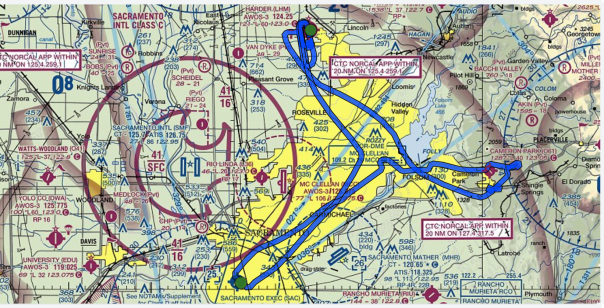
Checkride Route

$100 Hamburger

A few of us at work decided a couple of weeks ago to plan a fly-in to Sacramento Executive airport (KSAC) and have lunch at the Aviator’s Restaurant in the airport terminal. Earlier in the week, some of us met to discuss routing and other considerations for the fly-in. I was the only student in the mix and the rest were planning to arrive from Tracy, Reid-Hillview, Palo Alto and San Carlos. This would qualify for cross-country time in the logbook since KSAC was 51nm from KLVK.

My route would take me over the east end of Los Vaqueros reservoir, then directly to the Sacramento VOR and turning right to the airport nearby. On the way at Walnut Grove are three tall guyed radio towers which are each over 2000′ tall and one of the tallest structures in the world. Just for comparison, the World Trade Center towers were only 1368′ and the Eiffel Tower is 1063′ tall.

I met my CFI at the airport terminal at 8:30am to get a cross-country endorsement in the logbook. Previously I had briefed via Foreflight on my iPad for the weather and NOTAMS. It was going to get windy in the central valley starting around 11am but the winds were forecast to die down late in the afternoon at KSAC. The winds might still be right around my crosswind maximum of 10kts at KLVK so I discussed with my CFI that I will not takeoff until late in the afternoon and keep an option open to divert to KCCR Concord Buchanan airport.

To beat the winds I took off early and was airborne at 10:15am. Livermore tower now can initiate flight following and I had a squawk code dialed in before takeoff. Runway 34 is closed until Feb 15 and the winds were 320@7 favoring runway 30 and I was parked next to the terminal at 11:04. It took longer than the estimated 36 minutes for two reasons – the headwinds were stiffer than the forecast 335@17 at 5500′ cruising altitude and I forgot to lean the mixture for maximum engine performance.

Food and ambiance were quite good at the restaurant – I ordered a “$10 Pasta”. The seating area overlooks the taxiway and runway 02/20. We had a 13 people show up in 6 planes – one was a Lake and the rest were Cessna 172.

As we were lunching, the winds began howling outside from 320@17-28. Around 3pm the first plane (C172) from our group took off and we could see the wings rocking side to side as the pilot maintained runway course against the stiff crosswind. The rest of us hung out for another 30 minutes and slowly dispersed. I remained at the terminal checking the weather at Concord, Tracy and Livermore. Tracy was another option because the winds were generally lined up with runway 30.

Around 5pm I texted my CFI about my intentions to fly to Concord since the winds were from 360 and runway 01 would have been fine. Livermore had started to look better and he asked me to monitor that as well. I finished pre-flight, fueled up and called up ASOS one more time at both Concord and Livermore. When I took off from KSAC winds were 310@21-27.

KLVK 110053Z 01008KT 10SM CLR 19/M08 A2991 RMK AO2 SLP126 T01891078

The crosswind at Livermore was within my limits so I headed direct with the option to divert to Concord if needed. Climb out of Sacramento was bumpy but once I reached 4500′ cruise altitude, it was smooth air with a healthy tailwind. My airspeed was around 105 and at one point my ground speed was 138kts! En route, I saw the sun set in the west and in 25 minutes I was over Las Vaqueros reservoir. As I began my descent the winds picked up once again over the Livermore hills and tower first reported winds 340@8-21 and then 320@5-21 when I was on short final. The cross winds were quite stiff requiring full left rudder and right aileron to stay aligned with the runway on a forward slip. The landing was challenging but I was able to stick the landing. I was glad to be back safely on the ground, parked at 6:09pm, just within the 30-minute window after sunset at 5:41pm that my CFI had set as the limit.

In retrospect if I had had to divert from Livermore to Concord, it would have been a night solo for which I wasn’t endorsed. Departing 30 minutes earlier from Sacramento or heading only for Concord would have been safer options.

Dual Cross Country

We are flying a dual cross country today to Santa Rosa, then Sacramento Executive airport and back to Livermore. I worked on the planning checklist that I had assembled for the first cross country flight a while ago. I didn’t have time to determine winds aloft which is an important miss because it has a bearing on travel time, fuel consumption and wind correction angles. My plan was to use that checklist together with a paper chart. I had an iPad with Forelight only as a backup.

Winds are from 230@8 at Livermore at the time of takeoff. I used Scaggs Island VOR and then a from heading to Santa Rosa. It was particularly hard to spot the airport because it doesn’t come into view until after crossing Petaluma. Tower cleared us for a left traffic on runway 14. I was fairly high on the approach to Santa Rosa and couldn’t come down quickly enough for the landing so I did a go around. On the second approach there was a Horizon Air commercial aircraft holding short for my landing. We taxied and got our navigational details down for Sacramento before taking off.

There were hills close to Santa Rosa on the east so it wasn’t possible to depart left crosswind. We headed straight out, built up altitude before turning east. Along the way we spotted Vacaville and Davis and it was dusk by the time we neared KSAC. The landing was after sunset. The home stretch was largely uneventful in the dark, with the flashing red lights on windmills guiding our way back home.

Three learnings today:

  • situational awareness – know where you are at any point in time through dead reckoning.
  • Pre-flight – pay attention to terrain and winds aloft. There were hills close by and to the east of Santa Rosa. My plan to fly due east wouldn’t have been possible without adequate altitude to clear the terrain.
  • Dont trust the traffic pattern published in the AF/D. Santa Rosa was published as right traffic for Rwy 14. Tower instructs the traffic pattern.

First night cross-country flight

The days are getting long and that means sunset is later in the evening. A few days ago, Steve gave a route for Srinath to plan his night cross country trip. We were to leave Livermore for the Sacramento Executive Airport (KSAC), then Rio Vista (O88) followed by Kingdon (O20) and back to Livermore. We created a cross Cross Country Flight checklist as a PDF document with form fields and used this cross country trip as a trial subject. Anyways, we are now set with all the details and Srinath even received a full weather briefing through 1-800-WX-BRIEF. We were to meet Steve in the hangar at 8:30pm right around sunset. While night flying hours can be logged beginning with civil twilight, we were going to take off an hour after sunset.

Earlier this evening, Srinath had an appointment with the AME in Pleasanton to apply for a third-class medical certificate and it went pretty smoothly. It was a big relief!

We got to the hangar a little early and started the preflight checklist. When we flew a couple of days ago, we noticed that the landing light was not working and it had been placarded. It would be interesting to land without landing lights nevertheless Steve cleared us to go flying that night. We spent a good bit of time reviewing the planned details of the cross country trip with Steve. I set up Foreflight on my iPad so I could follow along the planned course.

Night flying is very different. First of all, there was no ATIS, no Ground or Tower controllers – it was past the operating hours – so we announced our intentions to Livermore Traffic on the CTAF. There were very few planes flying around at night and those that were flying could be spotted by their position lights. Depth perception wasn’t the same as while flying during the daytime. Thankfully this was a full moon night and the landscape was lit quite well. Watching from the back seat the moon rise over the horizon was quite a feeling. Photography was difficult due to extreme low light conditions. The GoPro picked up city lights but the rest of the time during our cruise it was pitch black outside and very dim inside the aircraft. The two massive towers (roughy 2050′ tall) northwest of Lodi stood out like sore thumbs.

Sacramento Exec airport was at first a little hard to find because it was engulfed by the city lights. There was another pilot announcing his intentions to take off from the airport while we were on the downwind leg. This landing turned out very smooth and we taxied off the runway to pause and regroup for the next leg to Rio Vista. En route to KSAC, we saw O88 to the west of the two massive towers so we simply looked for its airport beacon as we took off from KSAC. As I followed along on Foreflight, we basically tracked over the deepwater shipping canal. Suddenly we heard a high pitched sound and for a few seconds we were trying to figure out what was wrong. The terrain was almost pitch black so emergency landings would be impossible if needed. Thankfully it turned out be just a radio problem and we were able to resolve it quickly.

O20 Kingdon airport was almost impossible to find. It took quite a while to locate the airport in the darkness (see video). The airport didn’t have a beacon and the lights when keyed with the mike stayed on for just a couple of minutes. Srinath looked at the freeway and correctly guessed that we were almost overhead of the airport. Keying the mike proved it and we had quite a bit of altitude to lose. So we circled over the airport watching for any signs of winds as we shot for Rwy 30.The runway edge lights were placed quite far apart and that make it even more difficult to stay in the center of the runway. Finally the last leg back to Livermore was quite uneventful.

Here is the foreflight tracker. http://www.foreflight.com/s/track/1430886307-780FAB33-6427-4269-95FE-3B853966A072/